48
/ 7
Min Read
48
/ 7
Min Read



As the world marks World Tourism Day on September 27, this year’s theme, “Digital Agenda and Artificial Intelligence to Redesign Tourism,” could hardly be more timely.
It also arrives at a good moment for Indian tourism. According to the World Travel & Tourism Council (WTTC), the sector grew 7.3% in 2025, far outpacing the global average, and is on track to become the world’s fourth-largest travel economy within a decade. Domestic travellers are doing most of the heavy lifting, accounting for 86% of all travel spending last year.
|
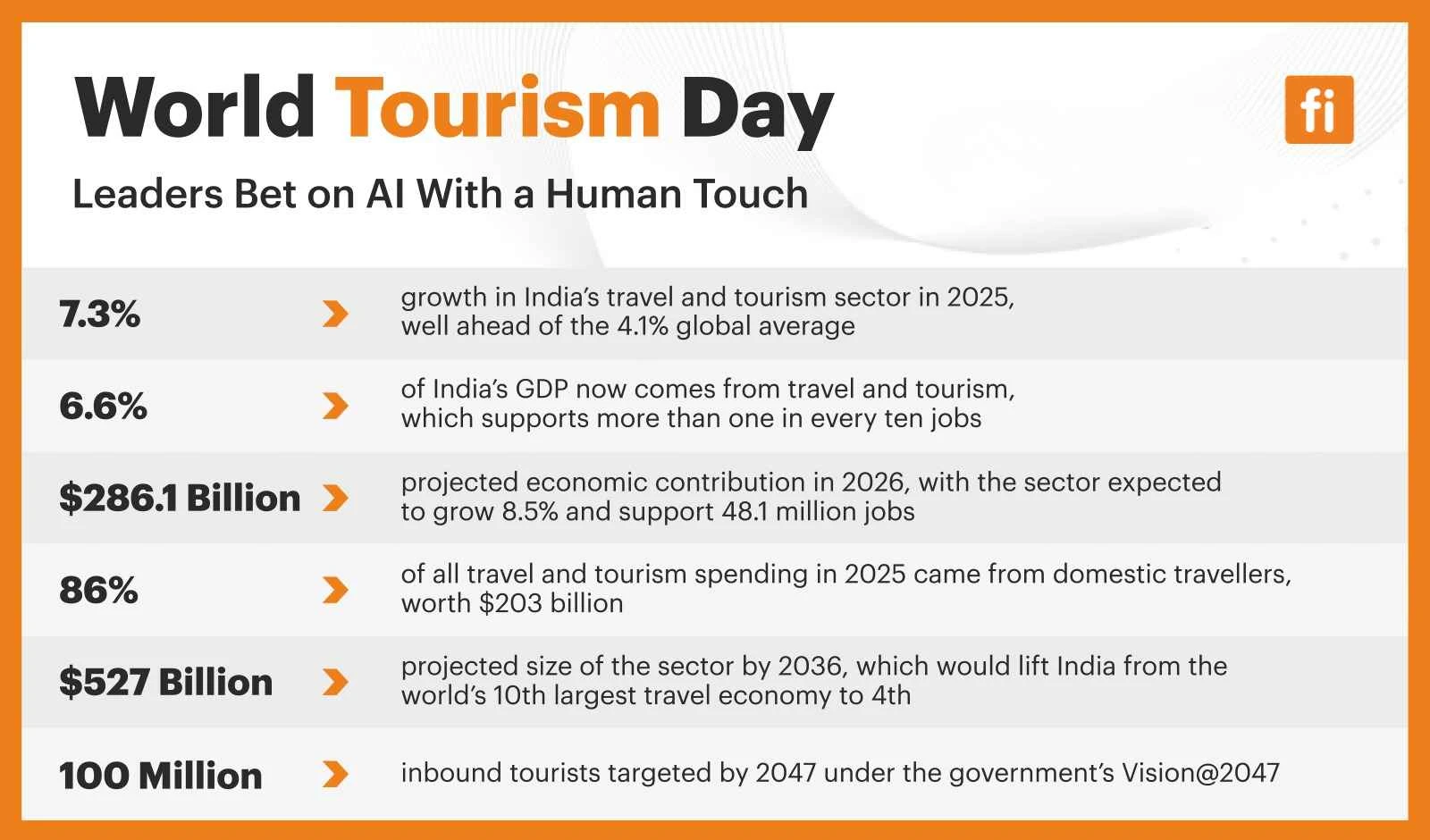
INDIA’S TRAVEL BOOM BY THE NUMBERS 7.3% growth in India’s travel and tourism sector in 2025, well ahead of the 4.1% global average 6.6% of India’s GDP now comes from travel and tourism, which supports more than one in every ten jobs $286.1 billion projected economic contribution in 2026, with the sector expected to grow 8.5% and support 48.1 million jobs 86% of all travel and tourism spending in 2025 came from domestic travellers, worth $203 billion $527 billion projected size of the sector by 2036, which would lift India from the world’s 10th largest travel economy to 4th 100 million inbound tourists targeted by 2047 under the government’s Vision@2047
|
|---|
AI is now part of the travel journey
Not long ago, AI in travel mostly meant a basic chatbot on a booking website. Today, it is woven into almost every step of how people plan a trip and Indian travellers are among the quickest to embrace it. Agoda’s 2026 Travel Outlook Report found that one in three Indians already use AI to plan their travel, while 68% say they are likely to use it for their next trip. An Allianz Partners survey put the figure even higher, with 82% of Indian travellers saying they have used or plan to use AI tools to plan a holiday.
“On this World Tourism Day, the theme of ‘Digital Agenda and Artificial Intelligence to Redesign Tourism’ captures the significant transformation underway across the global travel ecosystem,” says Rajeev Kale, President & Country Head – Holidays, MICE, Visa, Thomas Cook (India) Limited.
SD Nandakumar, President & Country Head – Holidays & Corporate Tours, SOTC Travel agrees that the change goes well beyond technology for its own sake. “Artificial Intelligence has moved beyond being simply a digital tool to becoming an increasingly important part of the customer journey, enabling personalization, faster responses and the ability to process an ever-growing range of travel choices,” he says.
At Radisson, the shift is already visible in the numbers. “AI-driven traffic to RH.com has grown to over 3% of visits and continues to accelerate,” says Nikhil Sharma, MD and COO, South Asia, Radisson Hotel Group. The group has backed this with a content readiness audit of 10,700+ prompts and nearly 297,000 responses across eight AI platforms and 135+ locations, to make sure its hotels show up when travellers ask AI for help.
Personalisation for a new kind of traveller
If there is one thing all three leaders agree on, it is that travellers now expect trips built around them, not one-size-fits-all packages.
“Today’s Indian traveller is increasingly seeking personalized, flexible and experience-led journeys, with greater interest in immersive experiences, wellness, spiritual tourism, adventure and premium travel,” says Kale. The opportunity in these niches is significant. A joint report by the Ministry of Tourism and NITI Aayog estimates that wellness tourism alone could add $18 billion to India’s GDP by 2030.
The real test for the industry, Kale says, is not the technology itself, but “how effectively we use it to understand and respond to the evolving traveller.” He believes digital tools can help travel companies “better understand traveller preferences, simplify the holiday planning journey and create experiences that are more relevant and personalized.” Nandakumar notes that AI can bring “speed, intelligence and personalization at scale,” something that would be hard for any team to do by hand.
Radisson is putting this into practice with Gemini-powered content and translation engines that personalise ads in more than 30 languages, along with semantic search, digital twins and VR tours that let guests explore a property before they arrive.
From discovery to booking: the rise of agentic AI
The next big change is AI that doesn’t just suggest a trip but acts on it. Known as agentic AI, these tools can search, compare and book on a traveller’s behalf.
Nandakumar sees real promise here. “As AI evolves towards more autonomous and agentic capabilities, it has the potential to make travel planning and servicing even more intuitive and responsive,” he says.
Radisson is already moving in that direction. Its ChatGPT discovery app covers more than 1,000 hotels and the group is preparing for the next step. “We are now advancing into agentic commerce so AI assistants can complete bookings directly while we retain the guest relationship and loyalty,” says Sharma.
That last point matters to the whole industry. As AI platforms become the place where trips begin, hotels and travel companies are keen to make sure they don’t lose their direct connection with the people who stay with them.
Removing friction behind the scenes
Not all of the change is visible to travellers. Some of AI’s most useful work happens quietly in the background.
“At Radisson Hotel Group, we are building AI at the centre so every hotel benefits without added complexity,” says Sharma. “The technology is designed once and delivered everywhere.” The group’s WhatsApp automation is now live in more than 20 hotels and has handled over 15,000 guest enquiries so far.
The aim, across the industry, is to make travel simpler. Kale speaks of using digital innovation to “simplify the holiday planning journey,” while Sharma puts it plainly: “The best AI quietly removes friction so our teams can deliver genuine hospitality.”
Why the human touch still matters
For all the excitement around AI, none of the three leaders believes technology can do the job alone. And with travel and tourism supporting more than one in every ten jobs in India, the question of how people and technology work together is more than academic.
“The future of travel cannot be defined by technology alone,” says Nandakumar. “A holiday is a deeply personal decision, often involving significant time, investment and individual expectations. While AI can bring speed, intelligence and personalization at scale, human expertise provides the context, judgement and accountability that technology cannot replicate on its own.”
Anyone who has had a flight cancelled halfway through a family holiday will understand what he means. SOTC’s answer is a collaborative model “where AI enhances human expertise rather than replaces it, combining technology-led convenience with expert curation and trusted guidance.”
Kale shares that view. “As technology changes how travellers discover, plan and experience the world, the tourism industry can combine digital intelligence with human insight,” he says. Even at Radisson, where AI is built into every hotel, the goal is to give staff more time for “genuine hospitality,” not to replace them.
With travel holding up despite the uncertainties of 2026, Nandakumar says this balance “will be critical in building more confident and meaningful travel experiences.”
The road ahead
With India’s travel economy projected to nearly double to $527 billion by 2036, the stakes are high. The traveller of the near future may well find a hotel through a chatbot and book it through an AI assistant. When something goes wrong in a foreign city at midnight, though, they will still want a person on the other end of the line.
As Kale puts it, the goal is a future where technology “does not simply make travel easier, but makes it more enriching, accessible and connected for travellers across India and the world.” On this World Tourism Day, that may be the industry’s most important message: technology can redesign tourism, but it is people who make travel worth taking.