95
/ 7
Min Read
95
/ 7
Min Read



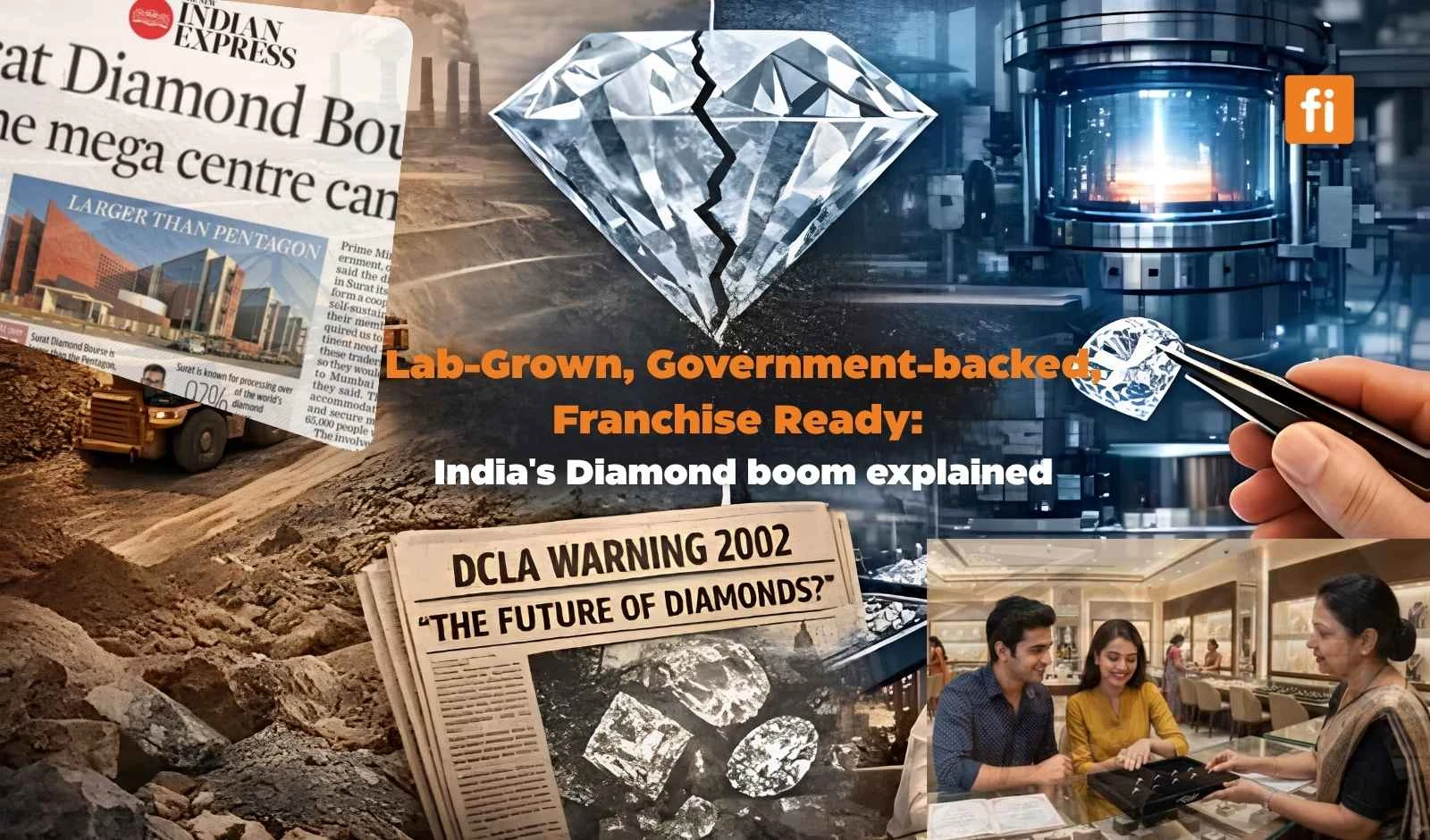
For generations, a solitaire on an engagement ring was a dream deferred, something a bride hoped for, saved for, or simply admired from behind a showroom counter, out of reach for most Indian households. Lab-grown diamonds have quietly closed that gap. The same brilliance, the same fire, the same “yes” moment, now within reach for practically any woman who wants it. That shift in accessibility is exactly why the category is booming in India right now: consumers have stopped treating lab-grown as a compromise and started treating it as the obvious choice and the government has begun actively backing the industry that makes it. Just a decade ago, lab-grown diamonds were a footnote in India’s jewelry trade, a curiosity certified by one international laboratory before the rest of the industry had even agreed on what to call them. Today, they are the subject of a Union Home Minister’s speech, a Tata Group brand launch and hundreds of crores in fresh funding aimed squarely at one thing: retail expansion. And increasingly, that expansion is being built store by store through franchising.
The Government Sets the Ambition
Speaking at the 52nd India Gems and Jewellery Awards in Mumbai, Union Home Minister Amit Shah laid out a vision far bigger than manufacturing alone. “India has the necessary infrastructure, skills, capital and capable entrepreneurs,” he told the gathering, adding that the country must ensure “the entire ecosystem and the complete manufacturing value chain for lab-grown diamonds are in the hands of the Indians.”
Shah pointed to projections that the lab-grown diamond market could grow to nearly 50 times its current size and argued that pace alone won’t be enough. India needs to transform the scale of its operations. The government, he confirmed, is preparing dedicated policies to hand India ownership of the full ecosystem: machines, manufacturing, jewelry, Indian brands and showrooms “in cities across the world.” The Prime Minister’s office, he added, stands ready to support the push.
IGI: The Trust Layer an Ecosystem This Size Will Need
Reacting to Shah’s remarks, Tehmasp Printer, MD & CEO of IGI India, offered a perspective shaped by a decade on the frontlines of certification. “For a decade, IGI backed lab-grown diamonds when much of the industry was still deciding what to call them,” he said, noting that IGI was the first international laboratory to certify the category.
Printer welcomed the Minister’s vision but was careful to flag what he sees as the missing piece. “An ecosystem of this scale cannot function on trust alone; it needs a trust layer,” he said, adding that as the conversation shifts “from price debates to questions of scale,” certification becomes the foundation everything else is built on. It’s a timely reminder: manufacturing capacity and government intent mean little if the consumer at the till doesn’t trust what they’re buying.
The Brands Racing to Build That Scale
While policymakers debate the ecosystem in principle, India’s sharpest jewelry brands are already racing to build it in practice, and the pattern across all of them is the same: raise capital, then spend it on stores. Titan set the tone by launching beYon, a dedicated lab-grown diamond brand run independent of Tanishq, Mia and Zoya, opening its first exclusive store in Mumbai in December 2025. By August 2026, it had already moved into North India, opening its second store in Noida ahead of the Raksha Bandhan festive season, a deliberate bet on gifting-led demand. “Noida is an important milestone in our expansion journey and reflects the growing appetite for contemporary jewellery across India,” said Shyamala Ramanan, Business Head at beYon, on the launch. Jewellery Division Head Arun Narayan has framed the brand around an India that has “always been defined by AND rather than or,” one where natural and lab-grown diamonds coexist rather than cannibalise each other, and rivals have largely read Titan’s entry as a validating moment for the whole category rather than a threat.
That capital is arriving fast. Palmonas folded lab-grown diamonds into its core 9KT and 14KT collections and backed the move with a $40 million Series B round, now opening eight to ten stores a month domestically while pushing into the Gulf with its first store in Abu Dhabi and a second in Dubai. A company spokesperson said Palmonas “sees significant long-term potential in the lab-grown diamond market,” but is building the category thoughtfully rather than chasing short-term revenue, a bet that lines up with projections of the global lab-grown diamond market roughly tripling, from $29.46 billion in 2025 to $91.85 billion by 2034.
Limelight Lab Grown Diamonds, already India’s largest dedicated LGD retailer, closed a ₹275 crore round explicitly earmarked for a mix of company-owned and franchise-operated stores, targeting 100 new outlets in 2026 and 200 by 2027; tellingly, the round itself drew participation from Limelight’s own franchise partners. Founder and MD Pooja Madhavan tied the strategy directly to the national conversation Shah has now amplified, saying the funding would help Limelight “build a world-class brand from India for the world.”
Solitario, co-founded by jewelry veteran Ricky Vasandani and actor Vivek Oberoi, makes the clearest case that franchising isn’t incidental to this category, it’s foundational. Built on a 30,000-square-foot Surat manufacturing base, the brand has scaled to dozens of exclusive stores in India and dozens more abroad, continuing to lean on local franchise partners, most recently in Kanpur and internationally, the Maldives, its eighth overseas market. “Our expansion into the Maldives is more than just a business milestone,” Vasandani said of that launch.
Notably, none of this growth is staying confined to Mumbai, Delhi and Bengaluru. Limelight has been opening stores in cities like Coimbatore and Bhopal alongside its metro outlets, and its next leg of expansion is explicitly aimed at Tier I and emerging Tier II markets. Solitario has been equally direct about chasing smaller cities, with Lucknow, Indore and similar markets sitting on its expansion list alongside the metros. It’s a telling shift: lab-grown diamonds are no longer being sold as a big-city phenomenon. Aspirational consumers in smaller towns, increasingly unwilling to wait for trends to trickle down from the metros, are turning out to be just as receptive to the category, which is exactly the kind of underserved, high-intent demand that makes a market attractive to franchisees.
Why This Is Becoming a Franchising Story
Lab-grown diamonds are unusual among high-growth Indian retail categories in that the hard part, reactor technology, cutting, polishing, design, is increasingly handled upstream by manufacturers and brand headquarters. What’s opening up downstream, at extraordinary speed, is retail real estate: hundreds of new stores that need operators, capital, and local market knowledge to run. That is precisely the gap franchising exists to fill, and brand owners in this category are treating franchisees as core infrastructure for growth rather than a secondary channel.
The timing is unusually favourable. Elevated gold prices have made lab-grown diamonds a genuine value proposition rather than a compromise purchase, widening the customer base for any new store, in smaller towns as much as metros. No single brand has yet cemented itself as the category’s default name in India, leaving real room for early franchise partners to grow alongside a brand instead of entering an already-saturated field. And with hundreds of crores of fresh capital, from Limelight, Palmonas and Solitario alike, earmarked specifically for store openings, including in Tier II and Tier III markets, over the next 18 to 24 months, brand-side funding and franchisee opportunity are moving in lockstep, backed by the certification credibility IGI has spent a decade building and the policy tailwinds Shah has now put behind the category.
For entrepreneurs weighing where to place their next bet, lab-grown diamonds are no longer speculative. By every visible signal, government intent, brand capital and consumer appetite are all pointing the same way.