
 104
/ 12
Min Read
104
/ 12
Min Read



PM-KUSUM Component B has emerged as a major opportunity in India’s solar agriculture market, with the scheme originally targeting 14 lakh standalone solar agricultural pumps. By August 2026, nearly 11,80,474 lakh standalone solar pumps had been installed under Component B, highlighting the scale of implementation. For solar pump manufacturers, vendors and EPC businesses, this creates a substantial market linked to government tenders, vendor empanelment and state-level allocations. This guide explains the PM-KUSUM Component B process in 2026, covering subsidy, eligibility, tendering, vendor selection, empanelment, allocation and key responsibilities from government approval through pump installation and after-sales service.
Key Takeaways
- PM-KUSUM Component B supports standalone solar agriculture pumps, with Central Financial Assistance (CFA) and state subsidy reducing the farmer’s upfront cost.
- Vendors participate through state-level tenders and empanelment processes, with eligibility, technical specifications, pricing and service obligations defined by the implementing agency.
- Vendor selection follows the applicable tender/EOI process, while MNRE allocates Component B capacity to states based on approved proposals, demand and implementation progress.
- Empanelled vendors are responsible for compliant equipment, installation, commissioning, warranty and after-sales service as specified in the tender and scheme guidelines.
- For businesses, understanding state-wise allocation, tender eligibility, technical requirements and vendor empanelment is essential before entering the PM-KUSUM Component B market.
Does the PM-KUSUM Scheme Provide Subsidy
The PM-KUSUM scheme provides financial assistance under Component B, for stand alone solar agricultural pumps to reduce the upfront cost for eligible farmers. Under the standard funding pattern, the Central Government provides 30% Central Financial Assistance (CFA) of the benchmark cost or tender cost, whichever is lower. The State Government provides at least 30% subsidy, while the farmer contributes the remaining amount.
For specified North-Eastern states, Sikkim, Jammu & Kashmir, Himachal Pradesh, Uttarakhand, Lakshadweep and Andaman & Nicobar Islands, the CFA is 50%, with at least 30% state subsidy and the remaining share paid by the farmer.
Under Component B, the subsidy is implemented through the designated State Implementing Agency, which selects and empanels vendors through the applicable tender process. The CFA and state subsidy are adjusted against the system cost, reducing the beneficiary’s payable amount. PM-KUSUM scheme guidelines (MNRE)
Component B Subsidy Structure
| Funding Component | Standard States | Specified Special States* |
|---|---|---|
| Central Financial Assistance (CFA) | 30% | 50% |
| State Government Subsidy | At least 30% | At least 30% |
| Farmer Contribution | Remaining 40% | Remaining 20% |
| Bank Finance | Up to 30% of System Cost | Up to 30% of System Cost |
| Initial Farmer Contribution with Bank Finance | 10% | 10% |
Note: CFA is calculated on the benchmark cost or tender cost, whichever is lower. The special CFA rate applies to the North-Eastern States, Sikkim, Jammu & Kashmir, Himachal Pradesh, Uttarakhand, Lakshadweep and Andaman & Nicobar Islands. State subsidy and financing arrangements are implemented through the concerned State Implementing Agency and applicable scheme guidelines.
Component B Subsidy: Step-by-Step Application Process
- Check eligibility
Confirm that you fall under the eligible beneficiary category and that the proposed pump is covered under Component B. Standalone pumps are primarily intended for off-grid agricultural areas.
- Apply through the State Implementing Agency
Visit the official PM-KUSUM portal or the designated state department/agency handling the scheme in your state. The National Portal provides state-wise implementation information.
- Complete the application form
Enter the required farmer, land and agricultural-pump details and upload the documents specified by the state agency.
- Pay the applicable beneficiary share
After the application is processed and the applicable pump/system is identified, the farmer pays the required beneficiary contribution. Bank finance is also available under the scheme, allowing the farmer to initially contribute 10% in the standard funding pattern.
- Vendor selection and installation
The implementing agency proceeds with the empanelled/selected vendor according to the applicable state tender and scheme process. The vendor installs and commissions the approved solar pumping system.
- Verification and commissioning
The installation is inspected and verified according to the applicable technical and implementation requirements. The subsidy is adjusted against the system cost, so the beneficiary pays only the balance amount after applicable CFA and state subsidy.
How Does The Component B Tender Process Work
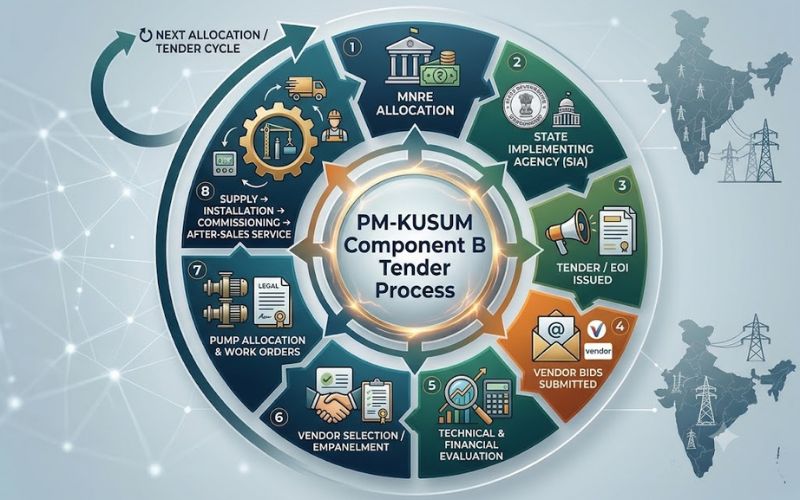
The Component B tender process begins with MNRE allocating pump capacity to states based on approved proposals, after which the designated State Implementing Agency (SIA) initiates procurement. The SIA issues a tender or EOI specifying the required pump capacity, technical standards, eligibility conditions, pricing and service obligations. Eligible solar pump manufacturers, suppliers and EPC agencies submit their technical and financial bids along with the required documents. The SIA evaluates the bids against the tender conditions and selects qualified vendors according to the applicable procurement method. Selected vendors receive the Letter of Award (LoA) or empanelment and subsequently receive work orders for supplying, installing and commissioning pumps for approved beneficiaries. The vendors also remain responsible for warranty and after-sales service as specified in the tender.
Common Solar Pump Tender Application Process
- Find the relevant PM-KUSUM Component-B tender on the concerned State Implementing Agency (SIA) or government e-procurement portal.
- Download the tender/NIT document and review the eligibility criteria, technical specifications, required documents, tender fee, EMD, and submission deadline.
- Check your eligibility against the requirements specified in the tender.
- Register on the designated e-procurement portal if you do not already have a bidder account.
- Arrange a valid Digital Signature Certificate (DSC) for authorised online bid submission.
- Pay the tender fee and EMD through the payment method specified in the tender document.
- Prepare the technical bid with all documents and certificates required under the tender.
- Prepare the financial bid in the prescribed online format, including the required pump/item-wise prices.
- Upload the technical and financial documents on the designated e-procurement portal.
- Digitally sign and submit the complete tender application before the specified closing date and time.
- Save the bid acknowledgement/reference number and submission receipt for future reference.
States-Wise Variations in Tender Application Process
| State / Implementation Approach | What Is Different From the Common Tender Application Process |
|---|---|
| Odisha | Vendor selection/empanelment has been handled through a centralised MNRE tender conducted by EESL, rather than a separate state-level vendor tender. OREDA then handles project distribution/allotment to selected vendors. (PM-KUSUM) |
| Telangana | Component-B implementation uses empanelled agencies/vendors, with Telangana's portal providing vendor, pump-capacity and service-centre information. The state material also refers to vendors selected through EESL/MNRE tenders, rather than showing a separate state tender application route. (PM Kusum Telangana) |
| Jharkhand | The state PM-KUSUM portal has a dedicated Component-B document and vendor/agency framework, with additional fields such as district, block, implementing agency and sanction year. The application/implementation system is therefore more granular at the local administrative level. (JREDA) |
| Rajasthan | The state uses its Solar Energy Data Management Platform (SEDM) for PM-KUSUM information and maintains an installers/empanelled-agency section. The vendor process is therefore integrated with the state SEDM framework rather than being presented only as a conventional standalone tender page. (PM Kusum Kerala) |
| Other states using centralised vendor selection | Where the SIA adopts vendors selected through the centralised MNRE/EESL Component-B tender, a business does not necessarily submit a fresh state Component-B tender application. The state subsequently works with the centrally empanelled vendors. MNRE maintains the central empanelled-vendor information. (Ministry of New and Renewable Energy) |
| States issuing their own procurement/empanelment tender | The common online tender process applies more directly: the bidder follows the state's NIT/RFP, registers on the specified e-procurement platform, submits the prescribed technical/financial bids and complies with the state's own fee, EMD, eligibility and documentation requirements. The exact conditions are tender-specific, rather than uniform across India. (eProcure) |
Basic Tender Eligibility Criteria for Tender Selection
| Eligibility Area | What the Tender Generally Checks |
|---|---|
| Legal entity | Valid company/business registration and required statutory registrations. |
| Technical capability | Ability to supply, install and commission the specified solar agricultural pump systems. |
| Financial capacity | Required turnover, net worth and financial documents specified in the tender. |
| Relevant experience | Previous experience in solar pumps, solar PV systems, government projects or similar work, where required. |
| Product compliance | Pumps, solar modules, controllers and other components must meet the applicable MNRE/BIS specifications and testing requirements. (PM-KUSUM) |
| Manufacturer/OEM requirement | Depending on the tender, bidders may need to be manufacturers, authorised manufacturers/OEMs or meet specified manufacturing/supply conditions. |
| Service infrastructure | Ability to provide installation, maintenance and after-sales service. MNRE's Component-B framework requires vendors to maintain service support, including authorised service centres in operational districts. |
| Service & warranty commitment | Acceptance of prescribed maintenance, warranty/AMC and inspection requirements. Component-B vendor responsibilities include design, supply, installation, commissioning and five-year asset maintenance cover. |
| Tender security | Ability to submit the required EMD/bid security in the prescribed form and amount. |
| Tender-specific declarations | Undertakings, affidavits, authorisations, tax documents and other declarations listed in the individual NIT/RFP. |
| Digital bidding requirements | Registration on the specified e-procurement portal and a valid Digital Signature Certificate (DSC) where required. |
Vendor Selection and Allocation Process For PM-KUSUM Component B
The official MNRE guidelines describe a tender-based vendor selection mechanism, while the State Implementing Agency (SIA) is responsible for beneficiary selection and scheme implementation.
- Tender is issued
The Central PSU or implementing agency issues a tender for the supply and installation of standalone solar agricultural pumps. The tender may be organised state-wise or region-wise.
- Eligible vendors submit bids
Eligible manufacturers/vendors submit their technical and financial bids according to the tender requirements. Under the MNRE framework, vendor selection is carried out through a tendering process.
- Technical and financial evaluation
The tendering agency evaluates the submitted bids and determines the applicable rates through the tender process.
- Vendors are selected/empanelled
Successful vendors are empanelled for Component-B implementation. The current national PM-KUSUM portal also maintains state-wise vendor lists and rate cards.
- Quantity is allocated among selected vendors
Under the original centralised tender framework, multiple successful bidders could be selected and the tender quantity allocated among them. The guidelines describe a 50:30:20 allocation among three selected bidders that agree to match the L1 rate, subject to the tender quantity and applicable tender conditions.
- Districts/areas are allocated
A cluster-based approach is used for allocating districts to selected vendors, with contiguous districts preferred where possible. The allocation is designed to match the pump requirement of the area with the quantity allocated to the vendor and support effective installation and after-sales service.
- Farmer selects an empanelled vendor
After the farmer's application is processed by the SIA, the farmer selects a vendor from the applicable empanelled vendors, according to the state's implementation procedure. MNRE's FAQ specifically states that the farmer can select an MNRE-empanelled vendor.
- Vendor receives the work/LOA and installs the pump
The selected vendor carries out the site survey, design, supply, installation and commissioning according to the applicable specifications and SIA requirements. Vendors also have prescribed post-installation responsibilities, including maintenance and service support.
State-Wise Variations In Vendor Selection And Allocation Process
| State | What Differs From the Common Vendor Selection & Allocation Process |
|---|---|
| Haryana | Haryana has a state-level vendor empanelment process and subsequently publishes selected vendors. The state also has a separate process through its PM-KUSUM portal for farmer vendor selection, followed by pump allocation/work orders. (HAREDA) |
| Telangana | Telangana's official portal specifically identifies vendors as empanelled through EESL tenders and MNRE allotment. It also provides state/district-wise vendor, service-centre and pump-capacity information. This makes the central tender/empanelment route particularly visible in the state's allocation system. (PM Kusum Telangana) |
| Rajasthan | Rajasthan has used centralised EESL/MNRE empanelment for Component-B vendors, with state-level empanelment orders issued for vendors selected through the central process. |
| Jharkhand | The state portal provides a more detailed allocation structure, allowing Component-B information to be viewed by state, district, block, implementing agency (EA), pump capacity and year. This reflects a more granular administrative allocation framework. |
| States using centralised empanelment | Vendors selected through the centralised tender are used by SIAs for Component-B implementation. MNRE's framework also permits SIAs to conduct their own tenders in specified circumstances, such as when required pump capacities were not covered in the central tender or sufficient vendors are unavailable. |
| States conducting their own tender | Where an SIA conducts its own Component-B tender, vendor selection follows the state-specific tender conditions, while the centralised tender price generally serves as the applicable ceiling under MNRE's provisions, subject to the specified exceptions. |
FAQs
Q. Can I apply for the PM-KUSUM tender when I have applied for another Government tender?
A. Yes, a business can apply for a PM-KUSUM Component-B tender while participating in another government tender, provided it meets the eligibility conditions of both tenders. However, each tender may have specific restrictions regarding ongoing contracts, technical capacity, financial eligibility, manpower, or available resources. Applicants should carefully review the respective tender documents before submitting their bids.
Q. What documents are required to apply for a PM-KUSUM Component-B tender?
A. The required documents vary by tender but generally include company registration documents, PAN, GST certificate, authorised-signatory details, financial statements, turnover and net-worth certificates, previous work orders or experience certificates, product certifications, manufacturer/OEM authorisation, EMD and tender-fee proof, declarations, affidavits, and technical documents specified in the tender.
Q. Is previous solar pump experience required to apply?
A. Previous solar pump experience is not universally mandatory for every PM-KUSUM Component-B tender. The requirement depends on the specific tender's eligibility conditions. Some tenders require bidders to demonstrate relevant experience in solar pumps, solar PV systems, or similar projects, while others prescribe alternative technical or manufacturing qualifications. Applicants should check the tender document before applying.
Q. How long does the PM-KUSUM Component-B tender process take?
A. The tender timeline depends on the issuing agency, tender size, bid submission period, evaluation requirements, and number of bidders. The tender document specifies the schedule for bid submission, technical evaluation, financial bid opening, and other stages. Applicants should follow the published tender schedule and monitor official portals for corrigenda or changes to important dates.
Conclusion
PM-KUSUM Component B offers a structured opportunity for solar pump vendors and EPC businesses through government-supported procurement. Understanding subsidy, tender eligibility, vendor selection, state-wise allocation and service requirements is essential for entering this market. Businesses should track state-specific tenders and the latest government guidelines to participate effectively and secure project opportunities.
Explore PM-KUSUM, solar, renewable-energy and agricultural business opportunities on Franchise India to discover relevant franchise and dealership options.
Read More: How to Start a Solar Power Business in India