
 42
/ 13
Min Read
42
/ 13
Min Read



India has installed 11,68,667 standalone solar irrigation pumps under PM-KUSUM Component B against a sanctioned target of 13,07,190, and state utilities are still placing orders in the tens of thousands — Shakti Pumps alone was empanelled by Maharashtra's MSEDCL for 10,000 pumps worth ₹235.92 crore in September 2026. For entrepreneurs, that demand opens four entry routes: dealership, distributorship, EPC/installation, and service and AMC. This guide covers what each model costs, how the PM-KUSUM subsidy actually reaches the vendor, which brands offer dealerships, where the profit sits, and the risks to plan for.
Key Takeaways
- India's solar water pump market is supported by rising interest in renewable irrigation and government-backed programmes such as PM-KUSUM.
- PM-KUSUM Component B supports the installation of standalone solar agricultural pumps, creating opportunities for manufacturers, dealers, installers and service providers.
- Entrepreneurs can enter through different models, including dealership, distributorship, EPC/installation and maintenance services.
- Startup investment ranges from about ₹5 lakh for a service-and-AMC operator to ₹50 lakh or more for a distributorship.
- The opportunity extends beyond pump sales: installation, AMCs, repairs and spare parts are recurring revenue, and the PM-KUSUM five-year maintenance obligation makes service capacity mandatory for scheme vendors.
Why the Solar Water Pump Business Is Growing in India
Diesel pumps cost farmers upwards of ₹90 a litre to run, and agricultural grid supply is unreliable or absent in many districts. A solar pump runs on sunlight during exactly the hours irrigation is needed, with no fuel bill and minimal running cost. That is why farmers, dairy units and rural water-supply schemes are switching from diesel and grid-electric pumps to solar.
Government support is the second major driver. Under the PM-KUSUM scheme, the Centre funds 30 per cent of a standalone solar pump's benchmark cost and the state funds at least another 30 per cent; the farmer pays 10 per cent upfront and the balance is bank-financed. Several states top up their share so that farmers in some categories pay as little as 5–10 per cent, which is why demand is concentrated in Maharashtra, Haryana, Rajasthan and Uttar Pradesh. PM-KUSUM scheme guidelines (MNRE)
Market Size and Growth of Solar Water Pumps
India’s solar water pump market is witnessing rapid growth, driven by rising demand for solar-powered irrigation and strong government support under PM-KUSUM. The number of standalone solar pumps installed under the scheme rose from 6.16 lakh as of December 2024 to 8.53 lakh as of July 2025, while the latest government data puts the country’s installed off-grid solar pump base at nearly 11.49 lakh as of June 2026. This steady expansion signals a growing opportunity for businesses involved in solar pump sales, installation, maintenance and after-sales services, making the sector an attractive space for entrepreneurs exploring India’s renewable energy market.
Component B is the PM-KUSUM segment focused on standalone solar irrigation pumps, and it is the segment that creates the dealer and installer market. The MNRE PM-KUSUM dashboard reports 13,07,190 Component B pumps sanctioned and 11,80,474 installed as of 30 August 2026 — a gap of roughly 1.4 lakh pumps still to be supplied, before counting replacements, upgrades and sales outside the scheme. State procurement is the clearest demand signal. In September 2026, Maharashtra's MSEDCL issued Shakti Pumps a letter of empanelment for 10,000 off-grid solar photovoltaic water-pumping systems, covering 3 HP, 5 HP and 7.5 HP pumps, worth about ₹235.92 crore under the Magel Tyala Saur Krushi Pump Yojana, to be executed within 60 days of the work order. In July 2026, MSEDCL also placed 10,000-pump orders with Oswal Pumps and a 15,000-pump empanelment with Shakti Pumps, and Shakti won a 16,780-pump Component B order from Karnataka's KREDL in January 2026. Every one of these orders needs local installers, dealers and service partners to execute — which is where smaller entrepreneurs enter.
Government-reported cumulative standalone/off-grid solar pump installations under PM-KUSUM.
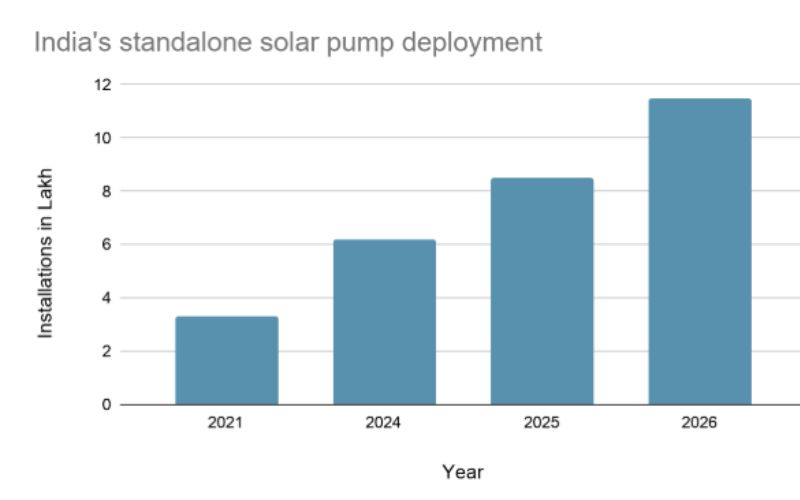
Sources: PIB/MNRE. 2024 and 2025 figures refer to PM-KUSUM standalone pumps; 2026 figure refers to off-grid solar pumps.
Who Is Buying: Farmers, Dairies, Rural Water Supply and Industry
Farmers remain the primary customer segment because solar pumps remove the diesel bill and the dependence on daytime grid supply. Demand also comes from dairy farms, rural drinking-water and livestock schemes and industrial or commercial sites where water has to be pumped and there is roof or ground space for panels.
For entrepreneurs, this means the business is equipment sales, project installation and long-term maintenance, not one-time pump sales.
Is the Solar Water Pump Business Profitable?
It can be, but the margin depends on which channel you sell into. Pumps supplied under PM-KUSUM are priced against MNRE benchmark costs and awarded on lowest-bid tenders, so per-unit margins are thin and payment arrives only after installation is verified; these projects work on volume, not margin. Direct sales to farmers outside the scheme, to dairies and to commercial sites carry better margins because pricing is negotiated, not benchmarked. On top of hardware, installation charges, annual maintenance contracts (AMCs), repairs and spare parts add recurring income — and established dealers consistently report that the service book, not pump sales, is what keeps the business profitable in years two and three.
Revenue Streams: Sales, Installation, AMC and Repairs
Revenue does not come only from selling pumps. The same customer pays again through installation and commissioning, annual maintenance contracts (AMC) and repairs. Under PM-KUSUM, the empanelled vendor is responsible for a five-year comprehensive warranty and maintenance on every installed system, so service capacity is a requirement of the business, not an optional add-on.
| Revenue Stream | How the Business Earns | Investor Benefit |
|---|---|---|
| Sales | Revenue comes from selling complete solar water pumping systems, including solar panels, pumps, controllers, mounting structures and related components. | Generates the primary upfront revenue and establishes the customer base for additional services. |
| Installation | Businesses charge for site assessment, installation, electrical connections, system setup, testing and commissioning. | Adds service income to every pump sale and creates an end-to-end business model. |
| AMC | Businesses charge customers for scheduled inspections, preventive maintenance, system checks and servicing under annual maintenance contracts. | Creates recurring revenue and provides long-term customer relationships. |
| Repairs | Revenue comes from troubleshooting, servicing and repairing pumps, controllers, wiring and other system components. | Creates ongoing service income from the growing installed base and supports repeat business. |
How Much Does It Cost to Start a Solar Water Pump Business?
There is no single government-prescribed startup cost, so the ranges below are FranchiseIndia estimates for a first-year operation, excluding premises.
| Business Model | Indicative Starting Investment | Main Requirement |
|---|---|---|
| Dealer | ₹10–25 lakh | Product inventory, showroom/office and working capital |
| Distributor | ₹20–50 lakh+ | Higher inventory, warehouse and distribution network |
| EPC / Installer | ₹15–40 lakh+ | Technical team, tools, vehicle and project working capital |
| Service-only (Installation & AMC) | ₹5–10 lakh | Tools, technicians, vehicle and spare parts |
Cost Breakdown: Basic Solar Water Pump Business Requirements
| Solar Water Pump Requirements | Approx. Investment |
|---|---|
| Inventory / advance procurement | ₹3–10 lakh |
| Tools & testing equipment | ₹1–2.5 lakh |
| Vehicle & transportation | ₹2–6 lakh |
| Working capital | ₹3–8 lakh |
| Staff / technicians | ₹30,000–₹80,000 per month (recurring — budget six months in working capital) |
Estimated initial requirement: approximately ₹10–25 lakh for a small installation/dealership-oriented business, excluding major premises costs.
Solar Water Pump Business Models: Which One Should You Pick?
The right model depends on your capital, technical expertise, inventory capacity and preferred role in the value chain. PM-KUSUM creates work for both equipment suppliers and installation/service providers, but eligibility for government-funded projects depends on the applicable tender and empanelment requirements.
| Business Model | Key Points | Approx. Investment | Main Revenue |
|---|---|---|---|
| Dealership | • Sell a specific brand • Operate within an agreed territory • Requires basic inventory and sales setup • Installation may be handled by authorised teams |
₹10–25 lakh | Pump sales |
| Distributorship | • Supply pumps to dealers/customers • Larger territory and sales volume • Requires warehouse and higher inventory • Higher working-capital requirement |
₹20–50 lakh+ | Product distribution |
| EPC / Installer | • Procurement and system design • Installation and commissioning • PM-KUSUM projects may require state-specific vendor empanelment/tender participation • Requires technical manpower |
₹15–40 lakh+ | Project execution + installation |
| Installation & AMC | • Installation support and maintenance • Repairs and spare-parts services • Lower inventory requirement • AMC creates recurring revenue |
₹5–10 lakh | Installation + AMC + repairs |
Choose the model based on your capital, skills and growth plans. Installation & AMC suits lower-investment entrepreneurs, while dealership, EPC and distributorship are better for those with greater capital or technical expertise.
| If you have | Recommended model | Why choose this model? |
|---|---|---|
| ₹5–10 lakh | Installation & AMC | Lower inventory and recurring service revenue |
| ₹10–25 lakh | Dealership | Ideal for sales-focused entrepreneurs |
| ₹15–40 lakh | EPC / Installer | Suits technically skilled entrepreneurs |
| ₹20–50 lakh+ | Distributorship | Suitable for higher working capital and larger sales volumes |
Note: For a first-time entrepreneur, Installation & AMC provides a lower-investment entry point, while EPC and distributorship provide stronger opportunities for business expansion with greater capital and operational capabilities.
PM-KUSUM Subsidy: What Dealers and Installers Need to Know
Under Component B the subsidy is released to the empanelled vendor, not handed to the farmer — which makes it the single most important cash-flow variable in this business.
- Funding split: 30 per cent Central Financial Assistance from MNRE, at least 30 per cent from the state, 10 per cent farmer contribution paid upfront; the balance is financed through bank loans or additional state subsidy.
- Benchmark pricing: MNRE publishes benchmark costs by pump capacity. The subsidy is calculated on the benchmark or the tender-discovered price, whichever is lower — so your selling price is effectively capped.
- Who can supply: only vendors empanelled by the State Implementing Agency (MSEDCL in Maharashtra, UPNEDA in Uttar Pradesh, RRECL in Rajasthan, and so on) through its tender, using MNRE-specified components including approved solar pump controllers and domestic-content modules where required.
- Payment cycle: the vendor collects the farmer's share, installs, and is paid the government share only after joint inspection and commissioning.
- Service obligation: a five-year comprehensive warranty and maintenance on every system installed under the scheme.
For a dealer or installer, this means carrying most of the pump cost for the period between installation and subsidy release. Working capital, not demand, is what decides who survives in scheme-linked business.
Solar Water Pump Franchise and Dealership Opportunities in India
Entrepreneurs can explore dealership and channel-partner opportunities with established solar-pump manufacturers. Investment requirements, territory rights and support vary by company and are often not publicly disclosed, so confirm them directly before committing capital.
Brands Offering Solar Pump Dealerships in India
| Solar Pump Brand | Model | Territory / Network | Support |
|---|---|---|---|
| Shakti Pumps | Dealer / system integrator / service partner | Pan-India; 1,200+ dealers and 400 service centres | Sales, installation and after-sales support |
| Lubi Pumps | Authorised dealer /channel partner | 2,500+ distributors across India | Product, dealer and service support; 1,000+ authorised service centres |
| Oswal Pumps | Dealer / distributor;PM-KUSUM empanelled vendor | Pan-India dealer network; repeat MSEDCL orders (10,000 pumps, July 2026) | Verify dealer terms with the company |
| Kirloskar Brothers (KBL) | Authorised dealer / channel partner | Pan-India; 16,000+ channel partners | Technical, installation and service support |
| Tata Power Solar | Dealer / EPC / vendor/ system integrator | Pan-India; 370+ channel partners across 240+ districts | EPC, installation and O&M support |
| Other MNRE-approved manufacturers | Dealer / EPC / vendor / system integrator | State- and project-specific | Depends on manufacturer and applicable programme |
Shakti Pumps appoints dealers and service partners within its distribution ecosystem and maintains a network of branches and service centres. The company is one of the largest PM-KUSUM vendors: in 2026 alone it was empanelled by MSEDCL for 15,000 pumps (July, about ₹353.89 crore) and a further 10,000 pumps (September, about ₹235.92 crore) under Maharashtra's Magel Tyala Saur Krushi Pump Yojana.
Read more: Shakti Pumps launches 4-inch plug-and-play submersible pumps.
How to Apply for a Solar Water Pump Dealership
Step 1: Shortlist the right company
Research established solar pump manufacturers and compare their dealership, distributor or channel-partner programmes.
Step 2: Contact the company
Reach out to the manufacturer's sales or business-development team through its official website or authorised contact channels.
Step 3: Submit your business details
Provide information about your investment capacity, location, sales experience, existing network, infrastructure and technical manpower.
Step 4: Complete the company's evaluation
The company may assess your local market reach, sales capabilities, storage facilities, technical team and ability to provide after-sales service.
Step 5: Verify dealership terms
Before signing, confirm the minimum investment, security deposit, territory rights, minimum purchase requirements, warranty responsibilities, training and installation support.
Step 6: Check service and spare-parts support
Confirm the availability of spare parts, technical assistance, warranty support and after-sales service in your territory.
Step 7: Check PM-KUSUM eligibility
For government-supported projects, verify the applicable state empanelment, tender and vendor eligibility requirements, as these differ by state.
Step 8: Sign the agreement and start operations
Once the commercial and operational terms are clear, complete the agreement, arrange the required infrastructure and begin sales or project execution.
Risks and Challenges to Plan For
- Payment cycles on government projects. The government share is released after inspection and commissioning; delays of several months are common. Dealers fail on cash flow, not on demand.
- Thin tender margins. Benchmark-linked pricing and lowest-bid awards squeeze per-unit margins, and you are bidding against listed manufacturers such as Shakti Pumps, Oswal Pumps and GK Energy that compete on scale.
- Compliance. Scheme installations must use MNRE-approved pump controllers, BIS-certified pumps and, where notified, domestic-content-requirement (DCR) modules. Non-compliant stock cannot be used on subsidised projects.
- Seasonality. Installation demand peaks before the kharif and rabi sowing seasons and slows in the monsoon; staffing and inventory have to follow that curve.
- Long service liability. The five-year maintenance obligation means technicians and spare inventory are a cost you carry for years after the sale.
- Policy dependence. State budgets and scheme phases change; Component B targets have been revised and extended more than once, and a state can pause sanctions for a year.
FAQs
What Licence or Registration Is Required?
You need GST registration, a shop-and-establishment or trade licence from the local body, and Udyam (MSME) registration, which helps with tender eligibility and bank credit. To supply pumps under PM-KUSUM you must also be empanelled with the State Implementing Agency through its tender, which sets turnover, experience and technical criteria.
Can I Start with ₹5 Lakh?
Yes — as a service-and-AMC operator. Tools, a vehicle, two technicians and a small spares inventory fit within ₹5 lakh. A dealership needs ₹10–25 lakh because brand inventory and the security deposit come first, and EPC or distributorship needs more again for working capital.
Which Brand Is Best for a Solar Water Pump Dealership?
There is no single best brand. Shakti Pumps, Lubi Pumps and Oswal Pumps are the most established names with dealer networks and PM-KUSUM empanelments. Compare security deposit, territory, minimum purchase, spare-parts availability and service support in your state before signing — terms are rarely published and change by region.
How Long Does PM-KUSUM Subsidy Take to Disburse?
There is no fixed timeline. The government share is released by the State Implementing Agency after joint inspection and commissioning; in practice it can take from a few weeks to several months depending on the state and its budget release. Keep enough working capital to cover that gap on every batch you install.
Conclusion
India's solar water pump sector offers opportunities across dealership, EPC, installation and maintenance models, supported by growing renewable-energy adoption and government programmes. Entrepreneurs should evaluate investment, local demand, technical capability and working-capital requirements before entering the market — and treat the subsidy payment cycle as the number that decides whether the business survives its first year.
Explore relevant solar, renewable-energy and agricultural-equipment franchise opportunities on Franchise India to compare available business options.
Read more: How to Start a Solar Power Business in India