48
/ 8
Min Read
48
/ 8
Min Read



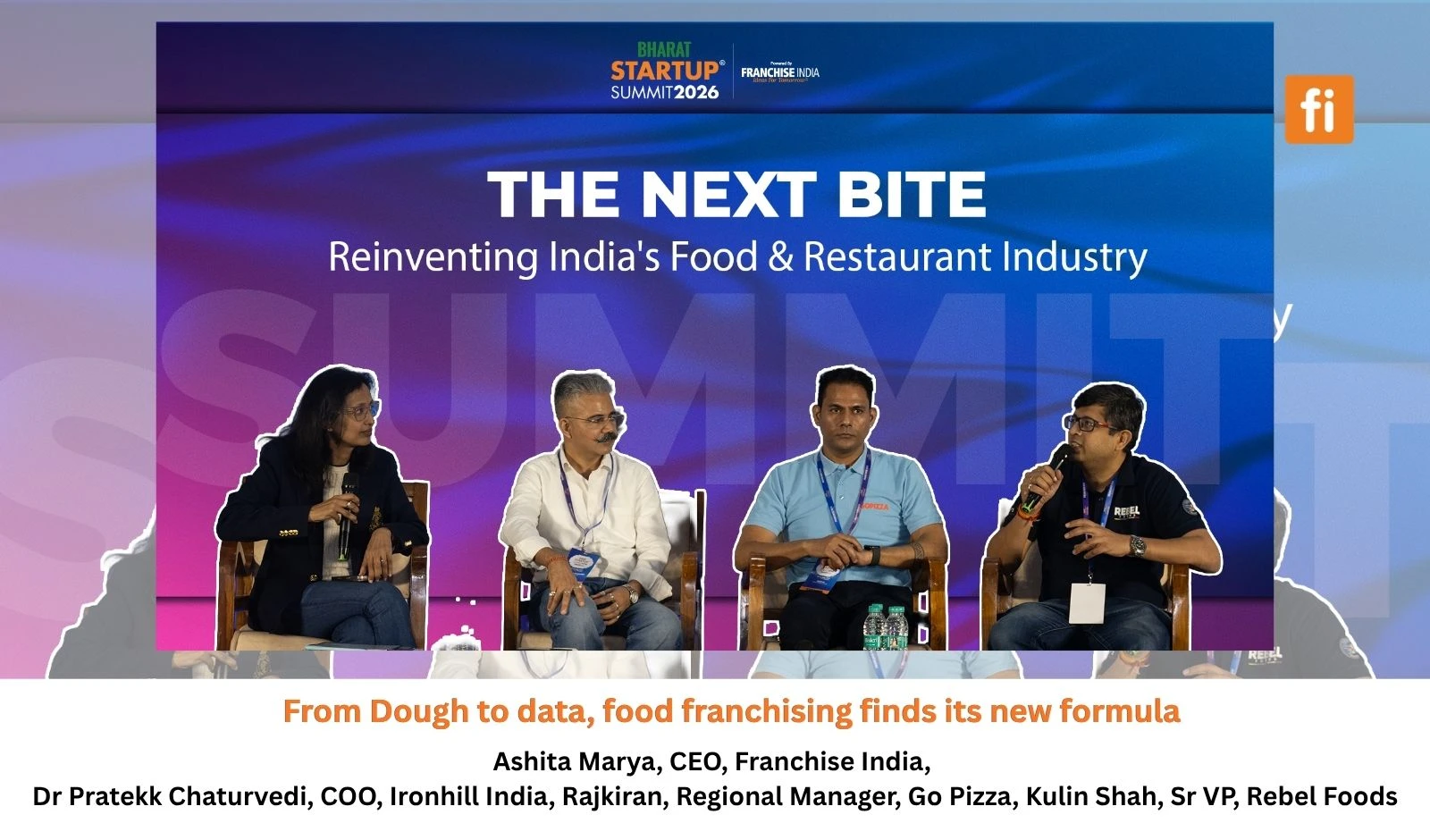
At a recent panel at Bharat Startup Summit in Bengaluru, themed as “Reinventing Franchising”, three leaders from very different corners of the food business showed how the model is splitting into new directions. Go Pizza India uses automation to run outlets as small as 80 sq ft. Rebel Foods turned a single Pune store into one of the world’s largest cloud-kitchen platforms. Ironhill is betting on giant, destination-style brewpubs in emerging city fringes. Between them, they set out a new-age playbook for food franchising, covering what to build, where to build it and who to build it with.
Three Formats, Three Big Ideas
For Dr. Pratekk Chaturvedi, COO, Ironhill India, the starting point was The Experience Economy, a book about branding not just the logo but the smell, taste and feel of a place. After Covid, his team saw that diners were willing to pay more for a better experience. Iron Hill describes itself as the world’s largest microbrewery, at 1.3 lakh sq ft with about 3,000 footfalls a day. “People are willing to stand 40 minutes in line. But that wait should be worth it,” he said.
Rajkiran, Regional Manager, Go Pizza India, took the opposite route: automation and compact outlets. The idea came from a labour shortage the brand faced in Korea. “In other countries there is a manpower shortage, and the average age of people working in the QSR model is about 50–55 years. That was when our founder decided we had to automate,” he said. Par-baked dough and robotics let Go Pizza serve a pizza in five to six minutes, against the seven to eight minutes typical of pizza chains.
For Kulin Shah, Sr VP, Rebel Foods, the big idea came from looking at rent. Around 2012–13, a survey showed nearly 80% of Faasos customers were comfortable ordering online. “Our capex was the same, but our rent was very high because we were on the high street. So why not close our stores and make them dark stores?” he said. When customers didn’t connect biryani with Faasos, the company created Behrouz as a separate brand, and the multi-brand cloud kitchen model was born.
Space, Size and Real Estate
Dr. Pratekk deliberately avoids city centres so that large formats stay viable. “Kind of like Walmart, we don’t want to be in the centre of the city at all,” he said. Iron Hill started in Visakhapatnam and Vijayawada, and is now expanding to the edges of cities, including beyond Hinjewadi in Pune and beyond Navi Mumbai. He sees a long runway ahead: “Today there are 4,000 microbreweries in the US. We have around 250–300 right now, with a population four times bigger. That boom is happening.”
Rajkiran’s advantage is the opposite: needing very little space. Go Pizza’s formats range from about 100 to 1,000 sq ft. “Our smallest outlet is about 80 sq ft, at Bangalore airport, and it generates revenue of about Rs 40–50 lakh. That kind of space we are able to manage with automation,” he said. The brand currently operates in Bengaluru, Hyderabad and Chennai, and runs about 10 outlets of its new Korean street-food brand.
Kulin said sharing one kitchen across many brands has changed Rebel’s economics. “From the same location we are serving multiple brands, so our unit costs have improved significantly.” Rebel now runs about 450 cloud kitchens serving more than a thousand restaurant brands, across India, Dubai, the UK and other European markets. It is now going omnichannel, with around 40 offline stores expected to double in a year. “We started offline, moved to cloud, and now omnichannel is picking up,” he said, adding that finding the right property is now the main constraint.
Keeping Quality Consistent Across Partners
Dr. Pratekk said franchisees must understand the experience they are selling and must give customers something they cannot get at home. Iron Hill’s “alchemy table” pairs 10 beers with a 10-course meal and events such as carnivals and Oktoberfest keep people coming. Yet he warned against over-innovating: “Our highest-selling items are mutton sambar rice and chicken sambar rice. Even though people come for the experience, they eat familiar food at the end of the day.”
Rajkiran said the biggest risk is expanding faster than training. “We have seen franchises increasing outlets without training being in place and that has impacted the outlets,” he said. He believes strong SOPs, training and AI will be key to optimising service across locations.
Kulin described Rebel’s layered quality checks, including random internal and external audits, CCTV monitoring and strict SOP training. Stores that score poorly are shut until they meet standards, whether they are franchised or company-owned. “Tech can enable us, but it’s the people who are doing the work on the ground,” he said. “Food is emotional. If you give a customer bad food once, you can lose that customer forever.”
Profitability and the Franchisee Relationship
Dr. Pratekk is rethinking how franchisees share in the brand’s growth. With plans to list in three to four years, Iron Hill is offering existing franchisees call options under which it would acquire 51% and make them subsidiaries and new agreements include the same clause after two years. “When we list, your profitability adds to our profitability, and our upside translates into your upside,” he said.
For Rajkiran, every outlet has to stand on its own. “Outlet-wise profitability is important,” he said, noting that Go Pizza recently shut two or three outlets that weren’t profitable. The company checks rent, staff costs and nearby brands’ sales before opening, and drops any site that falls below its threshold, “no matter how big or how good the site is.” It receives “almost 20–25 franchise enquiries every day” but will start franchising in India only once its supply chain is ready, “so that the franchisee doesn’t struggle and the ingredient cost is not higher.”
Kulin stressed that franchisees must be fully involved. “Food business is not that you invest and leave,” he said. Rebel is upfront during onboarding about the commitment needed, from consistent taste and constant innovation to government regulations and profitability. Partners who slip get warnings and support to course-correct.
Lessons Learned the Hard Way
Dr. Pratekk’s biggest lesson from 25 years in the industry is about ownership structure. “Too many cooks spoil the broth. In any franchise situation with more than two partners, we straight out decline it,” he said. He also checks why someone wants to enter the business, whether out of passion or simply for status, and insists the brand keeps the final say on SOPs and standards.
Rajkiran said the product has become the deciding factor. With brands now selling Rs 59 burgers and Rs 50 pizzas, “India has become a more price-sensitive, volume-driven market. A good product with reasonable pricing plays a very important role and this is changing the entire QSR model.”
Kulin pointed to a category Rebel didn’t get right the first time. Its South Indian cloud-kitchen brand didn’t take off in NCR around 2014–15. “Food is all about the product,” he said, adding that the company plans to try the category again as the market has changed.
The Next Decade on the Plate
Dr. Pratekk pushed back on the idea that Gen Z drinks less. “They are just drinking more carefully. They want to know what you’re putting in the product,” he said, adding that a zero-alcohol beer Iron Hill launched did not win repeat customers. His advice to the industry: “Don’t innovate for the sake of innovation.”
Rajkiran expects the next five years to be “technology-driven,” with convenience, accessibility and personalised food shaping demand, as protein-rich, fibre-rich and healthy products gain ground.
Kulin said Rebel’s health-focused brands are growing at about 500% a year, though from a small base, with its 500 Calorie Project among its best sellers in the Middle East. He noted that today’s diner is no longer tied to one cuisine. “They’ll order coffee on a weekday, go for experiential dining with family on the weekend, and order lunch in the office. So we have to be present across all categories and all food missions.”