
 19
/ 11
Min Read
19
/ 11
Min Read



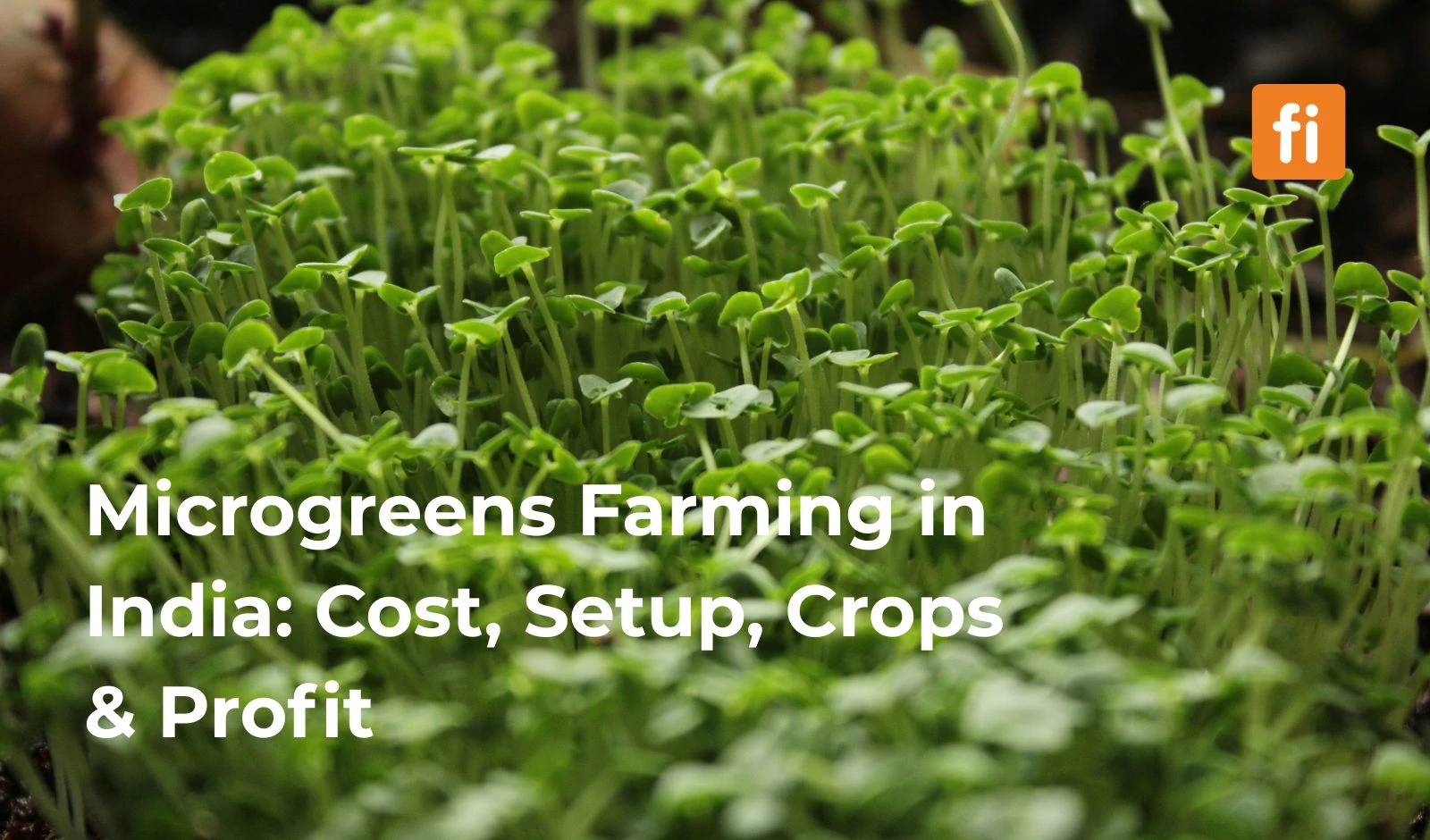
Suppose there was a way to produce an output that could be harvested in just a few days. Microgreens farming is an innovative idea which is becoming popular among entrepreneurs, health conscious people and food companies in India.
As opposed to traditional agriculture, the microgreens need less space and are quite ideal to be grown in a controlled environment, such as vertical farming. Whether it’s the sprouts of broccoli, radish, sunflower, or peas, with an appropriate selection of the crops to grow, farming methodology and target market, your small farm business is sure to become profitable.
The guide provides detailed information right from the capital investment, crops to grow, space requirements, farming methodology, marketing opportunities, and many more aspects.
Key Takeaways
- Microgreens require limited space and suit indoor, vertical and controlled growing setups.
- Radish, broccoli, mustard, sunflower and pea shoots are among the commonly grown varieties.
- Startup costs depend on the scale, growing system, equipment and level of environmental control.
- Short production cycles allow growers to plan multiple harvests within a month.
- Profitability depends on yield, crop choice, selling price, wastage and regular buyers.
- Food-related sales may require registrations or approvals depending on the business model and applicable rules.
What Is Microgreens Farming?
Micro-greens are the young edible vegetables that are harvested after the development of their initial leaves. They may be smaller in size compared to mature vegetables; however, they are popular because of their fresh look, taste and applications in salads, sandwiches, smoothies, cuisine, among others.
Micro-greens farming involves the cultivation of young vegetable crops in trays under appropriate conditions. The process works well under limited space, thus can be undertaken anywhere in urban environments including homes and commercial rooms where there are no available agricultural lands.
Examples of micro-green crops include radish, broccoli, mustard, sunflower, pea shoots, amaranth, basil, and coriander, among others. Different crops have different growth rates, yields, taste and market value. It, therefore, requires proper selection of crops.
The biggest advantage here is speed. You aren't waiting months for a full-grown plant; you harvest in a matter of days and ship it out. That quick cycle lets you continuously replant and harvest from the exact same trays all year round.
Is It a Good Business in India?
Growing microgreens is an enterprise that is well suited for entrepreneurs seeking a small-scale farm-based venture with multiple crop cycles. The attraction lies in the combination of its small scale, fast-growing nature, and high demand.
The business is particularly suitable for those who:
- Have access to a small indoor or controlled growing area.
- Prefer a production model that does not depend on large farmland.
- Wants to supply fresh produce to local food businesses and consumers.
- Are prepared to maintain consistent hygiene, quality and growing conditions.
- Have the ability to build regular orders rather than rely only on occasional sales.
The business model also provides space for incremental growth. A limited initial product line ensures that proper production practices are put in place and an understanding of demand is achieved. Growth in the customer base leads to more racks, trays, and crops.
The most important business consideration will be the ability to access the market. Microgreens are only fresh for a short period of time; therefore, proper planning, packing, and delivery are necessary to remain profitable.
Is Microgreens Farming Profitable
Microgreen cultivation presents lucrative business opportunities due to the quick harvest period, minimal growing area requirement, and high market value. Profitability is based on efficient production methods, crop selection, and a stable customer base.
Key factors influencing returns include:
- Crop selection: Each variety differs in seed cost, yield, growing period and market price.
- Production efficiency: Effective use of trays, racks and growing space improves output from the available setup.
- Selling price: Direct sales to households and premium food businesses often provide stronger realisations than bulk supply.
- Wastage control: Proper harvesting, packaging and order planning help protect margins by reducing unsold produce.
- Repeat demand: Regular orders from restaurants, retailers and households bring greater sales consistency.
A Starter Setup will help meet production costs and customer demand analysis before scaling up the business. After fulfilling the demands of existing clients, it is possible to increase the number of trays and the variety of plants to grow more crops and raise profits by expanding the business’s scale.
Popular Microgreens Crops to Grow in India
Crop selection has a direct influence on output, costs, and market demands. New growers always do well by initially planting reliable crops before diversifying to suit the tastes of the locals.
| Microgreen | Key Business Advantage |
|---|---|
| Radish | Fast-growing, distinctive flavour and widely used in salads and food garnishing |
| Broccoli | Strong appeal among health-conscious consumers |
| Mustard | Easy-to-recognise flavour and suitable for salads and culinary use |
| Sunflower | Larger shoots with good visual appeal and use in salads |
| Pea Shoots | Popular for their texture and fresh, mildly sweet flavour |
| Amaranth | Vibrant appearance suited to premium plating and garnishing |
| Basil | Attractive option for gourmet kitchens and specialty food businesses |
| Coriander | Familiar flavour with applications across Indian and contemporary cuisine |
A portfolio of mixed crops can be used to cater to varied customer preferences while minimizing reliance on one particular type of crop. The combination of radish, broccoli, mustard, sunflowers, and pea shoots serves as an excellent combination to begin with.
How to Start: Step-by-step
Starting a microgreens business involves setting up the growing environment, selecting suitable crops, establishing production practices and building a customer base. The key stages are:
| Stage | Explanation | Estimated Timeline |
|---|---|---|
| Choose the production model | Decide between a home-based, small commercial or controlled indoor setup based on investment and expected demand. | 1–2 days |
| Select microgreens | Choose varieties such as radish, broccoli, mustard, sunflower and pea shoots based on local demand and production suitability. | 1–2 days |
| Prepare the growing space | Clean and organise the production area with suitable ventilation, lighting, water access and working space. | 2–5 days |
| Install equipment | Set up racks, trays, growing media, lights, watering equipment and basic monitoring tools. | 2–4 days |
| Source seeds and supplies | Purchase quality seeds, growing media, trays and packaging materials from reliable suppliers. | 2–5 days |
| Start cultivation | Sow seeds and maintain appropriate moisture, airflow, light and temperature throughout the crop cycle. | 7–21 days* |
| Harvest and pack | Harvest at the suitable stage and pack the produce appropriately to maintain freshness. | 1 day per batch |
| Develop the customer base | Approach restaurants, cafes, premium grocery outlets and direct consumers to establish recurring demand. | Ongoing |
| Track costs and yield | Record input costs, harvest quantity, selling price and wastage after every production cycle. | Every cycle |
*The growing period varies by microgreen variety and production conditions. A basic operation generally reaches its first harvest within 2–4 weeks from setup, including preparation and crop growth.
Setup & Space Requirements
Microgreens farming works well in compact indoor spaces, with vertical racks helping increase production without requiring large farmland. The setup should provide clean growing conditions, adequate airflow, reliable water and suitable lighting.
| Requirement | Purpose / Estimated Requirement |
|---|---|
| Growing trays | Hold the growing medium and individual crop batches. |
| Racks or shelving | Support vertical production and maximise floor-space use. |
| Seeds & growing medium | Provide the foundation for healthy crop development. |
| Lighting & ventilation | Maintain suitable growing conditions, particularly for indoor production. |
| Watering & monitoring tools | Maintain moisture and track temperature and humidity. |
| Harvesting & packaging supplies | Support clean harvesting and fresh-product handling. |
| Starter space | 50–100 sq. ft. for home-based production and initial testing. |
| Small commercial space | 200–500 sq. ft. for regular local orders. |
| Commercial space | 500–1,000+ sq. ft. for larger production and B2B supply. |
The required area ultimately depends on tray capacity, rack design, crop mix and production targets. A clean, organised room with vertical shelving provides a practical starting point for a small operation.
Microgreens Farming Cost in India
The investment needed for establishing a microgreens farm is based on the production capacity and the growing method. The amount of money invested for setting up an indoor farm is low, while that for a commercial farm is high.
Estimated Startup Cost
| Expense | Starter Setup | Small Commercial Setup |
|---|---|---|
| Racks and shelving | ₹10,000–₹20,000 | ₹30,000–₹60,000 |
| Growing trays | ₹3,000–₹7,000 | ₹10,000–₹20,000 |
| Seeds and growing media | ₹5,000–₹10,000 | ₹15,000–₹30,000 |
| Lighting and electrical setup | ₹5,000–₹12,000 | ₹15,000–₹30,000 |
| Ventilation and monitoring | ₹3,000–₹7,000 | ₹8,000–₹15,000 |
| Packaging and basic tools | ₹3,000–₹6,000 | ₹7,000–₹15,000 |
| Working capital | ₹5,000–₹10,000 | ₹15,000–₹25,000 |
| Estimated Total | ₹34,000–₹72,000 | ₹1–₹1.95 lakh |
These are planning estimates, not fixed market prices. Rent, electricity, equipment quality, production scale and crop selection influence the final investment. A home-based setup with an existing suitable room also reduces the initial capital requirement.
Microgreens Yield, Selling Price, Revenue & Profit
Yield and selling price vary by crop, tray size, production conditions and sales channel. The following figures provide a simple planning model for a small commercial setup.
| Parameter | Estimated Figure |
|---|---|
| Yield per tray | 200–500 g |
| Example trays per cycle | 100 |
| Production cycles | 2–4 per month |
| Estimated monthly production | 40–120 kg |
| Indicative selling price | ₹300–₹800 per kg |
| Potential monthly revenue | ₹12,000–₹96,000 |
Estimated Monthly Profit
| Particular | Amount |
|---|---|
| Example monthly revenue | ₹60,000 |
| Seeds and growing media | ₹12,000 |
| Electricity and water | ₹4,000 |
| Packaging | ₹5,000 |
| Delivery and logistics | ₹5,000 |
| Miscellaneous expenses | ₹4,000 |
| Estimated operating profit | ₹30,000 |
These figures are planning estimates rather than fixed market returns. Crop selection, realised selling price, yield, wastage, order volume and operating costs determine the final profit. Rent, salaries, taxes and loan costs also need to be accounted for when calculating net profit.
Licences & Registrations for Your Business
The registrations required for a microgreens venture depend on the business structure, location and how the produce is handled and sold. Key areas to check include:
| Registration / Approval | Relevance |
|---|---|
| FSSAI Registration/Licence | Relevant where the business falls under applicable food business activities, particularly handling, processing, packaging or selling food products. |
| Udyam Registration | Provides MSME recognition for eligible enterprises. |
| GST Registration | Applicability depends on the nature of supplies, turnover and other conditions under GST rules. |
| Local Business Permissions | Municipal or state-level permissions may apply based on the premises and business activity. |
| Business Registration | A proprietorship, partnership, LLP or company structure may be selected according to the scale and ownership model. |
The National Single Window System (NSWS) provides a central platform to identify and access applicable approvals across central and state governments. Entrepreneurs should verify the requirements for their specific location and business activity before starting commercial operations.
Government Schemes & Financial Support
Microgreens businesses operating through controlled, vertical or protected cultivation should check agriculture and horticulture schemes applicable to their location and project structure. Support varies by scheme, state and eligible infrastructure.
| Scheme / Support | Potential Relevance |
|---|---|
| Agriculture Infrastructure Fund (AIF) | Financing support for eligible agriculture infrastructure projects, including certain controlled-environment and post-harvest infrastructure. |
| Mission for Integrated Development of Horticulture (MIDH) | Supports eligible horticulture development activities through applicable components and state programmes. |
| State Horticulture Schemes | Individual states offer schemes covering selected horticulture and protected-cultivation activities, subject to eligibility. |
| Agriculture Infrastructure & Market Linkages | Eligible projects may explore support related to storage, post-harvest management and other agricultural infrastructure. |
Before applying, entrepreneurs should check the latest eligibility conditions, eligible assets, financing terms and state-specific implementation guidelines through the relevant government department.
FAQs
1. How long do microgreens stay fresh after harvesting?
Freshly harvested microgreens generally have a short shelf life and require proper refrigeration and packaging. Their freshness also varies by crop, moisture level and handling. Quick packing and delivery help maintain quality.
2. What is the best growing medium for microgreens?
Suitable growing media include coco coir, peat-based mixes and other clean, moisture-retaining media designed for seedling production. The medium should provide adequate moisture, drainage and root support without introducing contaminants.
3. Do microgreens need direct sunlight to grow?
Microgreens require sufficient light for healthy development, but direct sunlight is not always necessary. Indoor farms often use suitable grow lights to provide consistent illumination, particularly where natural light is limited.
4. What causes mold in microgreens?
Excess moisture, poor airflow, overcrowding and contaminated seeds or growing materials are common causes of mold. Clean trays, controlled watering, adequate ventilation and hygienic handling help reduce the risk.
Conclusion
The concept of microgreens cultivation integrates small-scale production, rapid harvesting and an increasing demand for quality vegetables. The business thrives with a proper choice of crops, regulated production, cost control and sustained demand.
For potential entrepreneurs, operating on a small scale is a good way to start learning about production and demand. With proper planning and execution, the microgreens farming concept is a good route for business in the evolving urban agriculture sector in India.
Looking to explore more business opportunities in India? Discover promising franchise and business ideas with Franchise India and find the right opportunity for your investment goals.
Read More: 7 Profitable organic farming business ideas