77
/ 6
Min Read
77
/ 6
Min Read



At the recently concluded Bharat Startup Summit 2026 in Bengaluru, three retail leaders explained why franchisees now drive their growth, and why the right partner is judged on much more than capital.
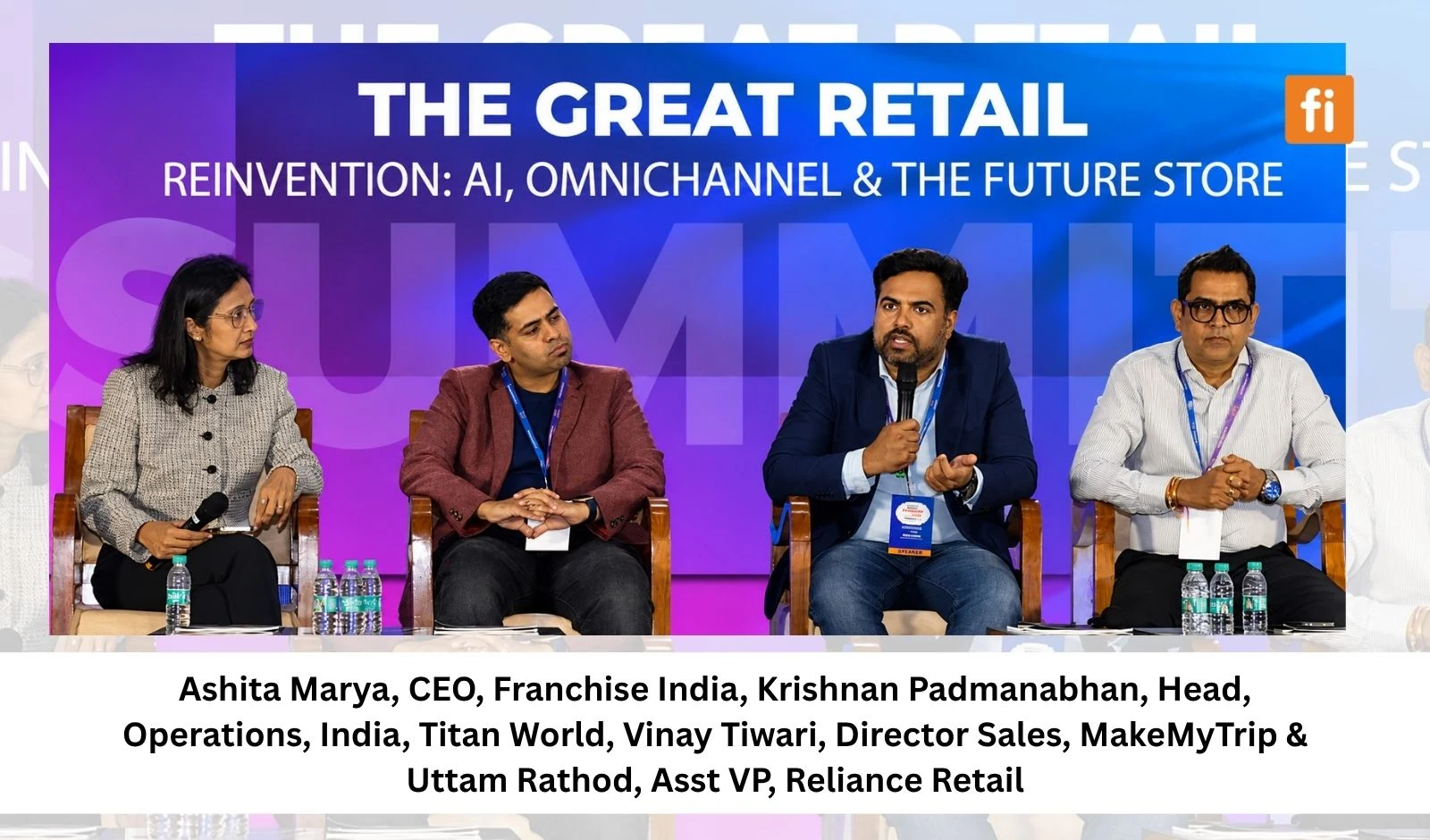
Franchising has quietly become the engine of Indian retail expansion. As brands push past the metros into towns where they have never had a presence, the local franchisee has moved from the edge of the growth plan to its centre. This shift came through clearly at a panel on "The Great Retail Reinvention: AI, Omnichannel & Future Stores" at the Bharat Startup Summit 2026, where Krishnan Padmanabhan, Head – Operations, India, Titan World; Uttam Rathod, Asst VP, Reliance Retail and Vinay Tiwari, Director Sales, MakeMyTrip, explained how their companies grow through partners. "The philosophy is that we want to create travel entrepreneurs across India," Tiwari said. Rathod was just as clear about smaller markets: for Tier-2 and Tier-3 towns, "we firmly believe that we need to partner with franchisees." Padmanabhan described what those partnerships should become: "the relationship between the company and the partner should be lasting and should benefit partners over time."
Choosing between company stores and franchise stores
Each company has drawn its own line between the stores it runs itself and those it hands to partners. Titan, which has more than 1,300 watch outlets, over 500 jewellery stores and more than 800 eyewear stores, leans heavily on franchising. "About 85% of our network at a company level is franchise stores, and 15% is company," Padmanabhan said. New businesses start with company-owned stores in premium markets such as Mumbai, Delhi and Bengaluru, but once a business is established, franchising becomes the default. "We only go ahead with company stores if the viability for a partner in that particular catchment is not meeting the business expectation," he explained. MakeMyTrip goes further still and runs no company-operated stores at all. "Travel is a very personal subject," Tiwari said, which is why the company wants local entrepreneurs, not employees, behind its counters. Reliance Retail splits its approach by format. Rathod said the company runs large-format stores alongside smaller standalone stores for labels such as John Players, Lee Cooper, Zivame and Amante, and it is these smaller stores, especially in Tier-2 and Tier-3 towns, that it sees growing through franchise partners.
What makes the right partner
On the question of who makes a good franchisee, all three speakers looked well beyond the size of the cheque. For Titan, culture and commitment come first. "We look at the background of the partners, the kind of portfolio they have, preferably within retail, and if not retail, what their involvement would be and how they are going to manage it," Padmanabhan said. MakeMyTrip starts with passion. "The first requirement for a franchisee is that he has to be a travel enthusiast," Tiwari said, adding that the company also weighs a partner's standing in the community. "We judge the social currency of a franchisee," he explained, looking at how outgoing a person is, how large their network is and whether they already run a business with a big customer base. Travel experience is not essential, though related businesses such as forex, visa services or consumer retail help. Rathod said that in Reliance's smaller formats, customer expectations around service and experience are very high, so the company needs partners who can deliver that personal attention every day.
Local knowledge as a competitive edge
All three companies treat a partner's knowledge of the local market as one of their most valuable assets. Titan prefers franchisees who live in the same town or city as the store, so that the person running it understands the customers walking through the door. Tiwari gave a vivid example from Gujarat, where many travellers prefer vegetarian food even abroad and often travel with a maharaj, a personal cook who carries groceries from home. "Even in Antarctica, they will try to have dhokla," he said. In markets like these, MakeMyTrip relies on a well-connected local partner, while in cosmopolitan Delhi and Mumbai it prefers partners with a retail background. Rathod made the same point for smaller towns: a franchisee who knows the town and its customers can give the kind of service that is hard to deliver from a distance, which is why Reliance sees local partners as essential to growth beyond the metros.
Starting small and scaling up
The companies also match the size of the investment to the partner and the market. Titan brings new partners in gradually, usually starting with a watch or eyewear store, where investment and risk are lower, before they "graduate into a jewellery business over a period of three to five years," Padmanabhan said. MakeMyTrip has three formats for different budgets: Experience Centres in metros at ₹25–30 lakh, Exclusive Stores in Tier-2 cities and smaller state capitals at ₹10–15 lakh, and Exclusive Store Minis of 200–300 sq. ft. for Tier-3 and Tier-4 towns. Even the smallest format can deliver big results. "Last to last week, we opened a store in Imphal, an Exclusive Store Mini, and in the first week itself we booked a group package costing almost ₹1.2 crore to Antarctica," Tiwari said. "Indian consumers are unpredictable. We are finding demand everywhere for travel." Reliance, for its part, uses its compact standalone brand stores as the entry point for franchisees in smaller towns.
A partnership built for the long term
The final theme was that the relationship does not end once a store opens. Titan reviews its partners' financial health throughout the partnership. "It is not a one-time thing," Padmanabhan said. "That check helps us understand the PBT levels of our partners over a period of time." MakeMyTrip uses 25 years of customer data from its digital platform to study demand in a region before opening a store, so a franchisee starts with a clear view of the market. Rathod framed Reliance's franchise network as central to its next phase of growth, which depends on partners staying committed for the long haul.
The common thread: Credibility, fit and commitment
The three companies take different routes, but what they want from a partner is strikingly similar. Each looks for someone who understands the local market, shares the brand's values and is in it for the long term. For entrepreneurs, the panel's message was that money opens the door, but local credibility, retail understanding and the right cultural fit are what build a lasting franchise partnership.