14
/ 5
Min Read
14
/ 5
Min Read



Five years after it opened its first Indian store in Andheri East, 7-Eleven has quietly pulled down its shutters across the country.
The chain's outlets, spread across just two cities, Mumbai and Pune, had all closed by the end of September, Japan's Seven & i Holdings, 7-Eleven's parent, confirmed on Monday, Nikkei Asia reported. Reliance Retail, which held the master franchisee in India, has made no official announcement and has said nothing on record about why.
The popular verdict arrived fast: quick commerce did it. Why walk to a convenience store, the argument goes, when an app will deliver the same cold drink and chips in 10 minutes?
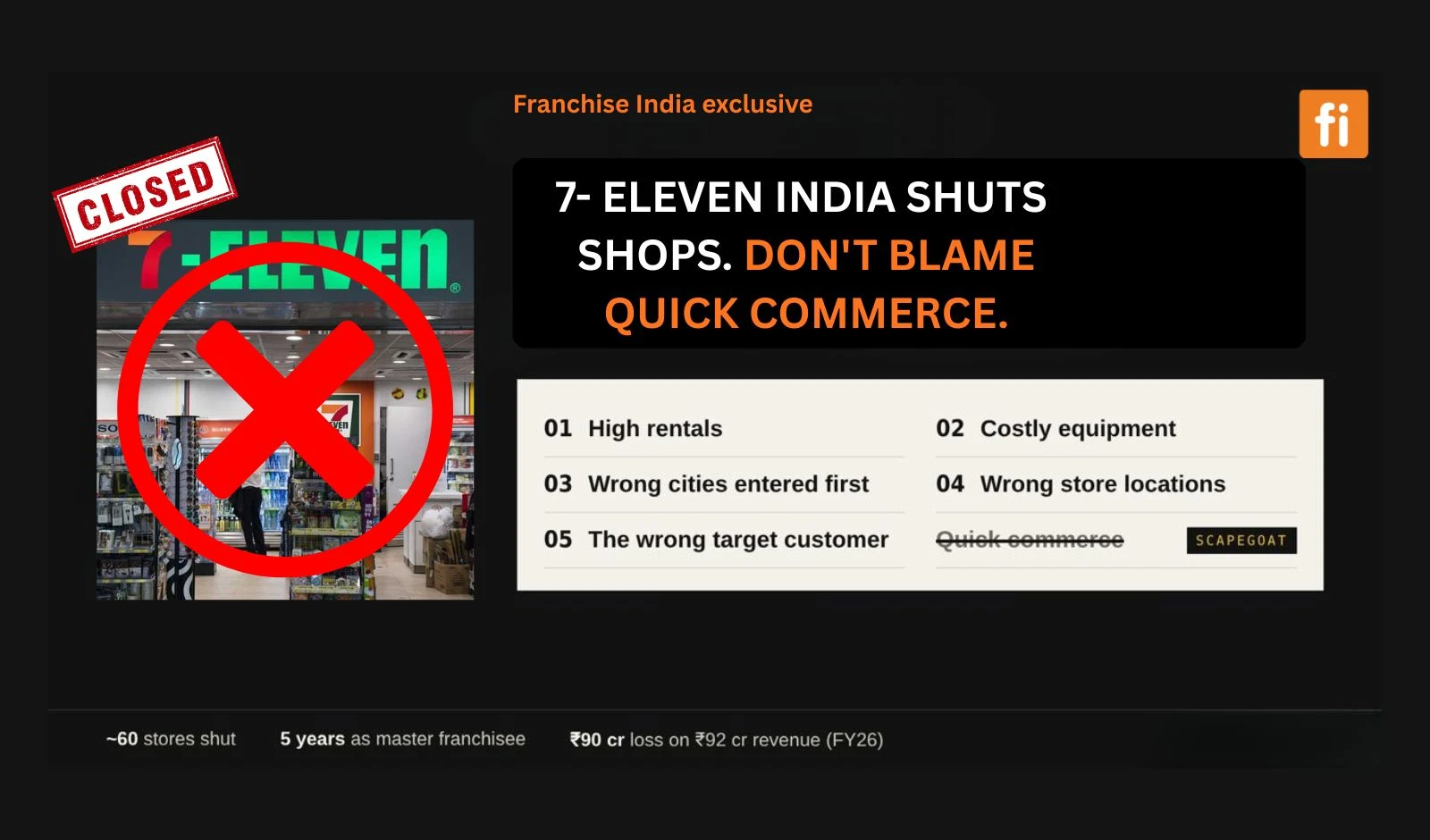
The real story is more complicated. It runs through steep rents, costly electronic equipment, a narrow two-city footprint and a customer who may never have been there, with quick commerce a distant last.
Many variables, not one villain
Within the company, the closure is not being read as the work of a single rival. The thinking inside, it is learnt, is that there were multiple variables at play and that quick commerce is the last of them, not the first.
Maybe it was the rent. 7-Eleven is built for prime, high-footfall urban corners, and in Indian metros those are among the costliest retail addresses in the country. A store selling coffee, snacks and impulse buys earns thin margins on every sale, and premium rent can swallow them whole.
Maybe it was the electronic equipment. A global convenience brand runs on costly technology, and the machines and tech infrastructure alone are estimated to cost between ₹8 lakh and ₹15 lakh per store. That bill covers enterprise-grade, cloud-linked billing terminals and contactless payment devices; open chillers with electronic temperature logging and IoT sensors to keep fresh food and dairy from spoiling; handheld barcode and RFID scanners that sync stock and supplier orders with the cloud for just-in-time restocking; Slurpee and bean-to-cup coffee machines; and anti-theft exit gates with networked CCTV for stores that never close.
For a small-format store earning thin margins on coffee and snacks, that is a steep upfront outlay, and it may have cost the business more than its sales could carry.
Maybe it was the cities. The chain never went beyond two: its stores were confined to Mumbai and Pune, among the costliest retail markets in the country. That choice and the specific locations within those cities, may simply not have been the right call. Top rent for footfall that never arrives is a fast way to lose money.
Maybe it was the customer. The convenience model rests on a shopper willing to pay extra for speed and proximity. In India, that shopper already has a kirana around the corner, often with credit, home delivery and lower prices. Neighbourhood stores still account for roughly three-fourths of FMCG sales in the country. If the chain was built for a customer who was never really there, nothing else could fix it.
Any of these could have been decisive. More likely, they worked together. Quick commerce, in this reading, is not the cause. It is the scapegoat.
Nor is the failure being laid at the door of the people who ran it. The team behind the stores is understood to have been diligent and to have worked hard. The problem was the model and the math, not the effort.
Five years, sixty stores
The numbers support the view that the trouble ran deeper than any single competitor.
Reliance Retail Ventures signed the master franchise agreement with 7-Eleven Inc in October 2021, through its wholly owned subsidiary 7-India Convenience Retail, and opened the first store on October 9 that year in Andheri East, Mumbai. It had stepped in days after Kishore Biyani's debt-laden Future Group walked away from its own 7-Eleven deal.
Five years later, the network had reached only nearly 60 stores, according to The Economic Times, and had never expanded beyond Mumbai and Pune. That was too few stores, in too few cities, to bargain hard on rent, supply or logistics. Around half had already been shut by the time the exit became public, PTI reported, with the rest selling off inventory before closing.
In the year ended March 2026, the venture earned revenue of about ₹92 crore and posted a net loss of nearly ₹90 crore, as per media reports. For almost every rupee it took in, it lost almost a rupee. That is not the profile of a healthy business undone by a new rival. It is the profile of a cost structure that never worked.
The lesson
It is easy to blame the apps. It is harder and more useful, to ask whether rent, equipment costs, city choices and the target customer were ever right for a format imported from Tokyo and Texas.
For a retailer of Reliance's size, closing a 60-store experiment is a footnote. For anyone hoping to crack convenience retail in India, it is a warning. The next attempt will not fail because of quick commerce. It will fail, as this one appears to have, by getting the basics wrong.