 57
/ 11
Min Read
57
/ 11
Min Read



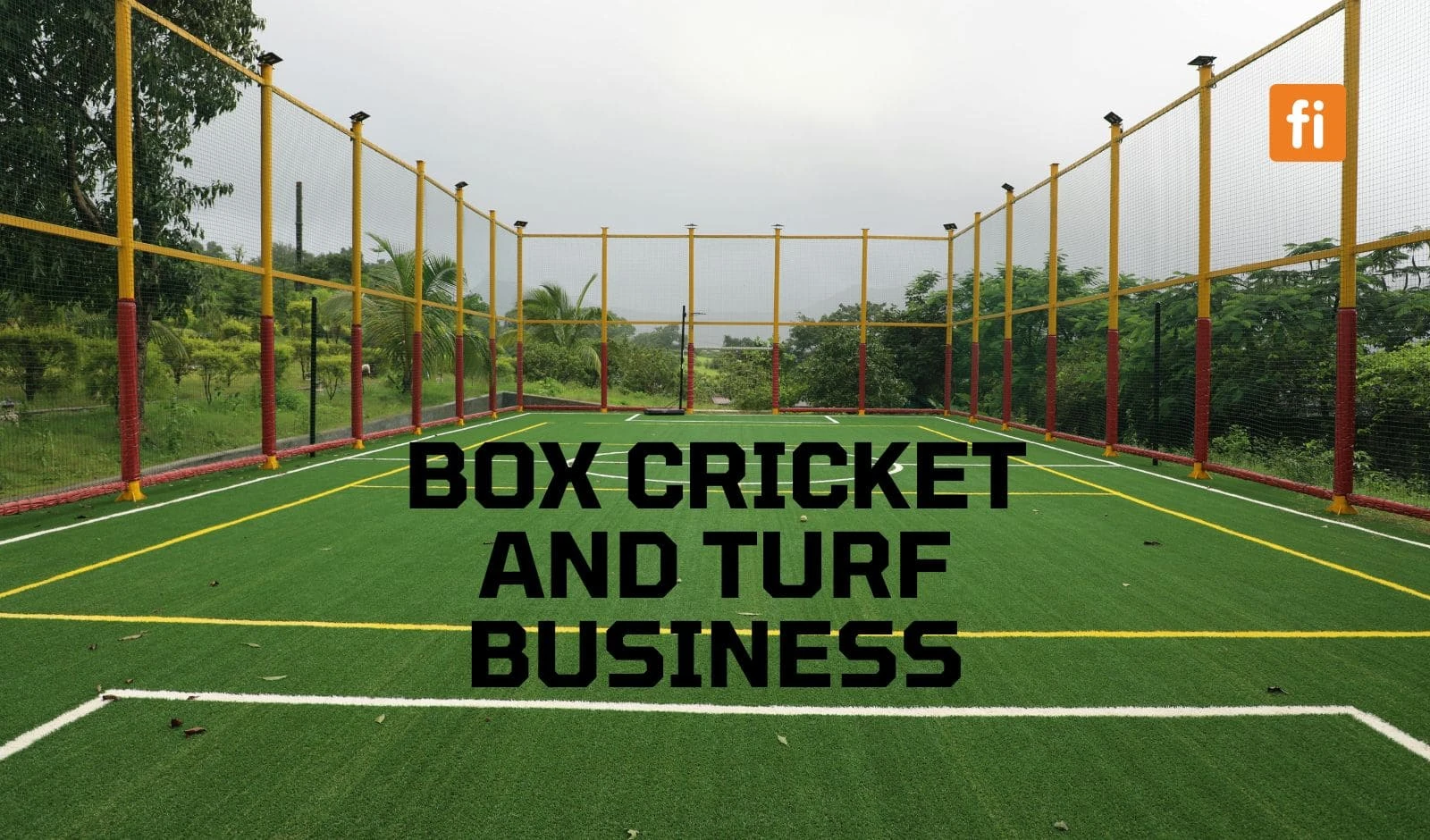
A piece of land that sits idle for most of the day could become a business where every booked hour generates revenue. Box cricket and sports turf are turning underutilised spaces into organised, paid-play destinations, creating opportunities around cricket, football, coaching, tournaments, corporate events and recreational bookings.
For entrepreneurs entering this sector, the key considerations are setup cost, land requirement, revenue potential and investment recovery. This article examines the box cricket and turf business opportunity, covering investment, space requirements, revenue models, profitability and ROI with practical examples for business planning.
Key Takeaways
- Box cricket franchise investment starts around ₹20–30 lakh, with 6,000–6,600 sq ft space listed.
- Turf businesses typically require 5,000–10,000+ sq ft, depending on the format.
- Bookings, coaching, tournaments, memberships and events form the main revenue streams.
- Location, utilisation, pricing and operating costs directly influence profitability and ROI.
- Entrepreneurs can choose between franchise, independent operation and turf construction models.
Box Cricket vs Turf Business: What’s the Difference?
The difference is that though they operate on a similar booking-based model, they differ in their format, investment requirements and revenue opportunities. Box cricket typically refers to an enclosed cricket facility, while the turf business can include cricket turfs, football turfs, multi-sport arenas and turf-related infrastructure services.
| Factor | Box Cricket Business | Turf Business |
|---|---|---|
| Primary focus | Box cricket facility | Sports turf/arena |
| Business models | Franchise and independent facilities | Independent, franchise and service models |
| Sports | Primarily cricket | Cricket, football and other sports |
| Investment | Franchise, land/lease and facility setup | Land/lease, turf and infrastructure |
| Revenue | Bookings, events, leagues, coaching | Bookings, coaching, tournaments, events |
| Key investment factors | Space, infrastructure and utilisation | Land, infrastructure and utilisation |
The investment required for either model depends on land or lease cost, facility size, infrastructure, location and expected utilisation. The following sections examine box cricket and turf opportunities through their setup costs, space requirements, revenue potential and ROI.
Box Cricket Franchise Options in India
A box cricket facility is suitable for both independent development and established sports-brand partnerships. Franchise models offer a structured business format, supported by branding, facility planning, training, marketing and operational assistance.
Some brands operating in this space include:
| Franchise Brand | Investment | Space/Land | Support / Format |
|---|---|---|---|
| Box Cricket | ₹20–30 lakh | 6,000–6,600 sq ft | Unit & multi-unit franchise; operating manuals and opening support |
| Sunrisers Sports Box | ₹30–50 lakh | 6,000–8,000 sq ft | Box cricket, futsal, volleyball and other indoor sports |
| Strike The Ball | ₹30 lakh | Not disclosed | Technology, marketing, training and operations |
| TurfNation Sports Arena | ₹25–75 lakh | Depends on facility | Multi-sport arena franchise; site evaluation, setup and launch support |
Investment, space requirements and franchise terms vary by brand and facility format. Entrepreneurs should verify the latest commercial terms directly with the respective brand before making an investment decision.
Box Cricket Franchise Setup Cost
The Box Cricket franchise listed on Franchise India requires an investment of ₹20–30 lakh, with an area requirement of 6,000–6,600 sq ft.
A practical setup budget within this range can be understood through the following indicative cost structure:
| Cost Component | Indicative Cost |
|---|---|
| Franchise investment | ₹20–30 lakh |
| Land/lease deposit | ₹2–5 lakh |
| Site preparation & base work | ₹5–10 lakh |
| Artificial turf | ₹2–4 lakh |
| Netting & steel structure | ₹1.5–3 lakh |
| LED lighting & electricals | ₹1–2.5 lakh |
| Sports equipment | ₹50,000–₹1 lakh |
| Branding, launch & signage | ₹50,000–₹1 lakh |
| Initial working capital | ₹1–2 lakh |
These are indicative planning figures, not a quoted franchise package. Individual costs may overlap with the franchise investment and vary according to the property, specifications and franchise agreement.
The biggest cost variables are land or lease expense, civil work, turf quality, enclosure structure and lighting. Entrepreneurs should therefore evaluate the complete project cost rather than treating the franchise investment figure as the total capital requirement.
Land Requirement
A box cricket business generally requires a commercial space of around 6,000–6,600 sq ft for the franchise format listed on Franchise India. The exact requirement depends on the playing area, enclosure, circulation space, reception and supporting facilities.
| Space Requirement | Indicative Area |
|---|---|
| Playing area | 4,000–4,500 sq ft |
| Netting & safety clearance | 800–1,000 sq ft |
| Reception & waiting area | 300–500 sq ft |
| Washroom/changing area | 400–600 sq ft |
| Storage & utility space | 200–300 sq ft |
| Total | 5,700–6,900 sq ft |
For a franchise model, planning around 6,000–6,600 sq ft provides a practical starting point. A property with good road access, adequate ceiling height, parking and reliable electricity is preferable because these factors affect customer convenience and facility operations.
The property can be owned or leased, but lease tenure should be aligned with the expected investment recovery period and franchise agreement. The Franchise India listing specifies a five-year franchise term, renewable as per its terms.
How Does This Business Make Money?
A box cricket business earns primarily through hourly bookings, but additional revenue streams can improve overall utilisation.
| Revenue Stream | Illustrative Pricing |
|---|---|
| Box cricket bookings | ₹800–₹1,500/hour |
| Tournament bookings | ₹5,000–₹15,000/event |
| Coaching sessions | ₹1,500–₹3,000/month/player |
| Corporate/group bookings | ₹3,000–₹10,000/session |
| League or membership packages | ₹2,000–₹5,000/player |
For example, if a facility achieves 6 booked hours per day at an average ₹1,000 per hour, monthly booking revenue would be about ₹1.8 lakh. Higher utilisation, premium evening slots and tournament bookings increase revenue.
The key factor is occupancy rather than pricing alone. A facility with consistent bookings across weekdays and weekends has greater revenue potential than one dependent only on peak-hour demand.
Is This Business Profitable?
A box cricket business can generate attractive returns when the facility maintains high booking utilisation and controlled operating costs. Profitability depends mainly on location, hourly pricing, occupancy, rent, staffing, electricity and maintenance expenses.
For example, at an average booking rate of ₹1,000 per hour:
| Daily Booked Hours | Monthly Booking Revenue |
|---|---|
| 4 hours | ₹1.2 lakh |
| 6 hours | ₹1.8 lakh |
| 8 hours | ₹2.4 lakh |
| 10 hours | ₹3 lakh |
If additional revenue from tournaments, coaching and corporate bookings is added, total revenue can increase further. However, revenue is not the same as profit. Rent, electricity, staff, maintenance, marketing and other operating expenses must be deducted before calculating net profit.
For a ₹20–30 lakh setup, the actual payback period therefore depends on the facility's utilisation, pricing and operating cost structure.
Turf Business in India: Business Models
Unlike box cricket, the turf business covers several formats, from operating a single sports facility to building turfs for other businesses.
| Business Model | How It Works | Typical Revenue |
|---|---|---|
| Own-and-operate turf | Develop and operate a sports turf | Bookings, coaching, events |
| Turf franchise | Operate under an established sports brand | Bookings, memberships, events |
| Multi-sport arena | Offer cricket, football and other sports | Bookings, tournaments, coaching |
| Turf construction & installation | Build turfs for clients | Installation, project contracts |
| Maintenance & AMC | Maintain existing sports surfaces | Maintenance contracts, repairs |
For entrepreneurs with suitable land, own-and-operate and franchise models provide direct booking revenue. Those without suitable property can explore turf construction, installation or maintenance services, where revenue comes from project and service contracts rather than player bookings.
The choice of model determines the required investment, land, infrastructure and revenue structure.
Setup Cost in India
The cost of starting a turf business depends mainly on land, turf size, surface quality and supporting infrastructure. A basic facility requires less capital, while a multi-sport arena needs a larger investment.
| Cost Component | Indicative Cost |
|---|---|
| Land/lease deposit | ₹3–10 lakh |
| Site preparation & civil work | ₹5–15 lakh |
| Artificial turf | ₹3–8 lakh |
| Fencing, netting & structure | ₹3–7 lakh |
| Lighting & electricals | ₹2–5 lakh |
| Equipment & basic facilities | ₹1–3 lakh |
| Branding & launch | ₹50,000–₹2 lakh |
For a single-sport turf, a project budget of roughly ₹15–40 lakh excluding land purchase can be used as an initial planning range. Multi-sport facilities require higher investment based on the sports and infrastructure included.
Actual costs should be finalised after evaluating the site and preparing a detailed project budget.
How Much Land Is Required?
A turf facility generally needs 5,000–10,000 sq ft for a single-sport setup, while a multi-sport arena may require 15,000 sq ft or more.
| Turf Format | Indicative Land Requirement |
|---|---|
| Small cricket/football turf | 5,000–7,000 sq ft |
| Standard turf facility | 7,000–10,000 sq ft |
| Multi-sport arena | 15,000+ sq ft |
Apart from the playing area, the site should provide space for entry, reception, washrooms, seating, parking and equipment storage. Properties with good road access, sufficient height and reliable electricity are generally more suitable for commercial turf operations.
Land can be owned or leased, with the lease period aligned with the expected investment recovery period.
How Does it Make Money?
A turf business primarily earns through hourly bookings, with additional revenue from organised activities and sports services.
| Revenue Stream | Illustrative Pricing |
|---|---|
| Turf bookings | ₹800–₹2,000/hour |
| Tournament bookings | ₹5,000–₹20,000/event |
| Coaching programmes | ₹1,500–₹4,000/player/month |
| Corporate/group bookings | ₹3,000–₹10,000/session |
| Membership packages | ₹2,000–₹5,000/player/month |
For example, at an average booking rate of ₹1,200 per hour, 6 booked hours per day would generate around ₹2.16 lakh in monthly booking revenue.
The revenue potential improves when the facility maintains bookings during weekday, evening and weekend slots, rather than relying only on peak hours.
Is it Profitable?
A turf business offers strong revenue potential when the facility maintains high utilisation, suitable pricing and controlled operating expenses. Location, rent, electricity, maintenance and customer demand are the key factors shaping profitability.
For example, at an average booking rate of ₹1,200 per hour:
| Daily Booked Hours | Monthly Booking Revenue |
|---|---|
| 4 hours | ₹1.44 lakh |
| 6 hours | ₹2.16 lakh |
| 8 hours | ₹2.88 lakh |
| 10 hours | ₹3.60 lakh |
Additional income from tournaments, coaching, memberships and corporate bookings strengthens the overall revenue mix.
After accounting for rent, salaries, electricity, maintenance, marketing and other operating expenses, the remaining amount represents operating profit. Higher booking utilisation supports faster recovery of the initial investment.
Box Cricket & Turf Business ROI: How to Calculate It
ROI measures the return generated against the initial business investment. A simple formula is:
ROI = (Annual Net Profit ÷ Total Investment) × 100
For example, if a turf facility requires ₹25 lakh and generates ₹6 lakh annual net profit, the indicative ROI is:
₹6 lakh ÷ ₹25 lakh × 100 = 24%
The same approach applies to a box cricket facility. The calculation should use actual net profit after rent, salaries, electricity, maintenance, marketing and other operating expenses.
| Investment | Annual Net Profit | Indicative ROI |
|---|---|---|
| ₹20 lakh | ₹4 lakh | 20% |
| ₹25 lakh | ₹6 lakh | 24% |
| ₹30 lakh | ₹8 lakh | 26.7% |
| ₹40 lakh | ₹10 lakh | 25% |
Higher utilisation and multiple revenue streams improve the overall return profile, while the final ROI depends on the actual project economics.
Box Cricket Franchise vs Turf Business: Investment Comparison
Both models use sports infrastructure and booking-based revenue, but their investment structure differs.
| Factor | Box Cricket Franchise | Turf Business |
|---|---|---|
| Indicative setup | ₹20–30 lakh* | ₹15–40 lakh+ |
| Space requirement | 6,000–6,600 sq ft* | 5,000–10,000+ sq ft |
| Primary revenue | Cricket bookings | Sports bookings |
| Additional revenue | Events, leagues, coaching | Events, coaching, memberships |
| Business format | Franchise-led | Independent or franchise |
*Figures based on the Box Cricket listing on Franchise India. Turf figures are indicative planning estimates and exclude land purchase.
The suitable model depends on available capital, property size, location, target sports and preferred business format.
FAQs
1. Is it better to buy or lease land for a turf business?
Leasing reduces the upfront capital requirement and keeps more funds available for turf and infrastructure. Buying provides long-term property ownership but requires substantially higher capital. The choice depends on available funds, location and the expected business tenure.
2. Which location is best for a box cricket or turf business?
Locations near residential areas, colleges, offices and commercial hubs provide access to regular players and group bookings. Road connectivity, parking, visibility and the availability of suitable commercial space also influence customer acquisition.
3. Is booking software necessary for a turf business?
A booking system helps manage slot availability, online payments, customer records and revenue tracking. It becomes particularly useful as booking volumes and the number of playing facilities increase.
4. What should be checked before taking a box cricket franchise?
Entrepreneurs should review the franchise fee, total setup cost, space requirement, royalty, agreement period, franchisor support, projected revenue assumptions and existing franchisee performance before signing the agreement.
Conclusion
Box cricket and turf businesses offer revenue opportunities through bookings, coaching, tournaments, memberships and events. The investment largely goes towards land or lease, turf, civil work, enclosure, lighting and supporting infrastructure, while profitability depends on location, utilisation, pricing and operating costs.
Choosing the right format requires a clear assessment of available capital, space, target customers and revenue potential. A detailed site evaluation and project budget should be prepared before investment.
Explore sports franchise and business opportunities with Franchise India to find the right model for your investment plans.
Read more: India’s Largest Rooftop Racquet Sports Hub