102
/ 8
Min Read
102
/ 8
Min Read


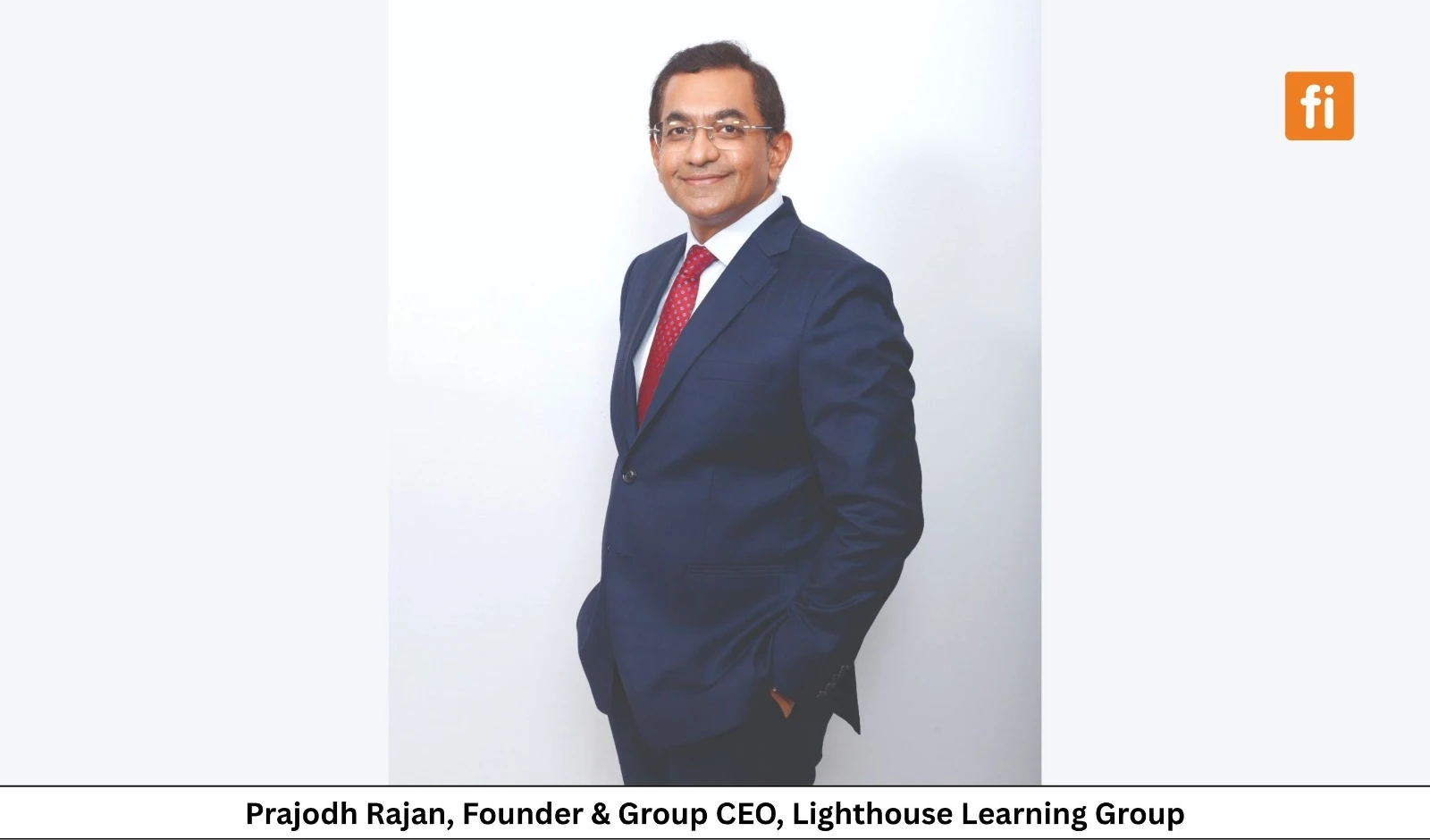
In a sector where growth often gets confused with success, Lighthouse Learning has spent twenty five years quietly proving that the two are not the same thing. What began in 1998 as a children's book publishing venture has grown into one of India's largest early childhood and K-12 School education groups, nurturing more than 200,000 children, through over 2,000 preschools and 61 K-12 Schools. Yet, ask Prajodh Rajan, Founder & Group CEO, Lighthouse Learning Group what he is proudest of. “Our most meaningful milestone is the trust we have earned over more than two decades and the part we play in shaping the citizens of tomorrow.”
THE ORIGIN OF AN IDEA
Lighthouse Learning's story does not begin with a franchise blueprint or a growth chart. It begins with books. The founders started out publishing children's literature driven by a conviction that meaningful learning depends on the quality of the experiences created for children. That conviction found a bigger canvas in 2001, when the company opened its first two EuroKids preschools in Mumbai, at a time when organised preschool education in India was still a nascent category.
“We saw a chance to bring structure, consistency, safety, and pedagogical rigour to the years that shape a child the most,” Rajan recalls. “From that first preschool our philosophy has stayed the same. Child First.”
Those early years taught the founders something that would shape every decision that followed. Early childhood education Rajan insists is deeply local. Every neighbourhood functions as its own micro market and a child is best served by someone who understands that community and treats the preschool as their own. That single insight would go on to define the company's entire growth strategy.
FROM INSIGHT TO INSTITUTION
Rather than build a chain of company owned centres, Lighthouse Learning built something more unusual for its time: a franchising model designed around what Rajan calls committed owner operators rather than passive licensees.
“It is why we never saw franchising as just licensing a brand name,” he says. “Education is a high trust category. Parents are entrusting us with their child's safety, development and first experience of learning.”
That trust as Rajan explains it demanded a model where support did not end once a franchise agreement was signed. Partners receive sustained backing across curriculum, teacher training preschool design operating systems, technology and continuous quality improvement while bringing their own local knowledge community relationships and entrepreneurial drive to the table. The result according to Rajan is a genuine partnership rather than a transaction. Today the network supports more than 1,850 women entrepreneurs who operate as owner operators building respected businesses within their own communities.
The model proved durable enough to survive the addition of an entire portfolio of brands. Kangaroo Kids - Mother's Pet Kindergarten and most recently, Early Learning Village joined EuroKids under the Lighthouse Learning umbrella building what is now one of India's largest preschool networks. In 2009, the company entered K-12 education with EuroSchool, followed over time by Billabong, Centre Point, Heritage, Experiential, Phoenix Greens, and Finland International School Maldives. The preschools grow through franchising while the K-12 schools remain self owned and operated. In 2021 the group renamed itself Lighthouse Learning, a name Rajan says was chosen to reflect the ambition of the ecosystem it had built rather than any single brand within it.
THE NEXT FIVE YEARS
Scale for its own sake, Rajan is quick to clarify was never the ambition. Yet, scale is exactly what lies ahead. Over the next three to five years, Lighthouse Learning plans to grow its preschool network from over 2,000 centres to more than 4,000 while expanding its K to 12 portfolio from 61 schools to 100.
“Every neighbourhood deserves access to a high quality early education school.” That is how Rajan frames the strategy behind the growth. Much of the expansion, he explains will come not from entering entirely new markets but from going deeper into the ones the group already serves building greater density within existing neighbourhoods and catchments. India's preschool market remains highly fragmented even today and Rajan sees that fragmentation as both the opportunity and the discipline required to address it responsibly. Sustained growth, he says comes from maintaining a strong curriculum, investing in educator capability, upholding safety standards and ensuring that each new preschool adds greater reach, trust, and strength to the overall network.
On the K-12 side growth will continue to be more selective, concentrated in markets where the group sees strong parent demand and where it can build institutions aligned with its educational philosophy.
READING THE SHIFTS IN INDIAN EDUCATION
Ask Rajan what is changing in Indian education and he does not talk about a single disruption but about several forces converging at once. Parents, he says continue to value academic achievement but are now equally conscious of communication, creativity, emotional wellbeing and adaptability pushing schools to move beyond an exam centred definition of success. There is also a growing recognition that the years before formal schooling are not simply preparation for Grade 1, but a foundational stage in which language, movement, relationships, curiosity and emotional security take shape.
Technology and artificial intelligence are reshaping the sector too though Rajan is careful about where he draws the line.
“Used thoughtfully technology can help educators personalise learning, identify gaps, improve assessment, and reduce administrative burden,” he says. “However technology must remain in service of the child and the teacher. It cannot replace human relationships, judgment, empathy, or the social experience of learning.”
The fourth shift he identifies is a rising expectation of transparency. Parents today want visibility into what their children are learning, how safety is ensured, how teachers are trained and how wellbeing is supported. Lighthouse Learning's response has been structural rather than piecemeal building out Digital Labs, a Central Education Team and a Centre of Wellbeing so that innovation is developed across the group instead of in isolated pockets.
“The real question,” Rajan says “is not whether an education organisation adopts the latest technology or trend. It is whether that innovation results in a better learning experience for the child.”
WHAT MAKES A PARTNER
For a company that has built its scale through franchising, the choice of partner is perhaps the single most consequential decision it makes. Rajan is candid about what he looks for and it is not primarily a resume.
“The most important quality we look for is alignment of intent.” An education background, local credibility, and strong people
management skills all matter, he says but what he prizes most is a willingness to stay actively involved and uphold
the brand's academic safety and operating standards as an owner rather than an investor.
That support Rajan says begins long before a preschool opens with help on location assessment, infrastructure, academic implementation, recruitment, teacher training and launch marketing and continues well after, through curriculum updates, technology platforms quality reviews and ongoing capability building. Some of the group's franchise partners, he notes with evident pride have stayed with the brand for nearly 25 years and continue to grow alongside it.
ADVICE FOR THE NEXT GENERATION
Asked what he would tell entrepreneurs hoping to build sustainable education businesses of their own, Rajan's answer begins somewhere unexpected.
“My first piece of advice would be to begin with the child not with the business model.” Education, he argues cannot be approached the way one might approach a purely transactional consumer category because trust takes years to build and can be lost very quickly. Every decision from the selection of educators to the design of classrooms and how parents are communicated with either strengthens or erodes that trust.
Beyond that Rajan urges patience and a willingness to play what he calls the long game choosing a franchise system, based on the strength of its educational and operating capabilities rather than the familiarity of its name staying closely connected to the community it serves and understanding that profitability and purpose are not opposing forces.
“A high quality education business must be financially sustainable in order to invest in teachers, infrastructure, innovation and long term improvement.”
A LEGACY STILL BEING WRITTEN
What Rajan wants Lighthouse Learning to be remembered for a decade from now has little to do with the size of its network.
“I would like Lighthouse Learning to be recognised as an institution that helped define what responsible scale in education should look like.”
From two EuroKids preschools in Mumbai in 2001 to an ecosystem reaching more than 200,000 children today, the milestone he keeps returning to is not the number itself but what it represents about how organised early childhood education became more structured, trusted, and accessible across the country.
It is a legacy Rajan frames in terms bigger than any single company. “Ultimately the legacy we seek is not simply to have built a large education group,” he says. “It is to have helped shape a stronger education ecosystem, one in which the child remains central, institutions act with responsibility and education is recognised as a critical force in nation building.”
Twenty five years in that vision, still begins the same way it did with two small preschools in Mumbai. Child First.