51
/ 6
Min Read
51
/ 6
Min Read


We are living in a business ecosystem where business models are evolving at an unprecedented pace. From traditional retail to e-commerce, quick commerce and a host of emerging formats, there is no shortage of innovative ways to reach consumers. Yet, amid this rapid evolution, a clear trend is emerging. While some businesses remain focused on chasing growth through numbers and valuations, the most successful players are concentrating on building robust systems, operational excellence and sustainable foundations. In today's competitive landscape, it is not merely scale that determines leadership, but the ability to create strong, replicable business models capable of delivering consistent growth over the long term.
For years, expansion was synonymous with scale. Brands raced to enter new cities, investors rewarded rapid growth and market share became the ultimate benchmark of success. Today, however, industry leaders are taking a more measured view. As consumer expectations evolve and competition intensifies, the focus has shifted from aggressive expansion to building businesses that can grow sustainably while maintaining quality, profitability and relevance.
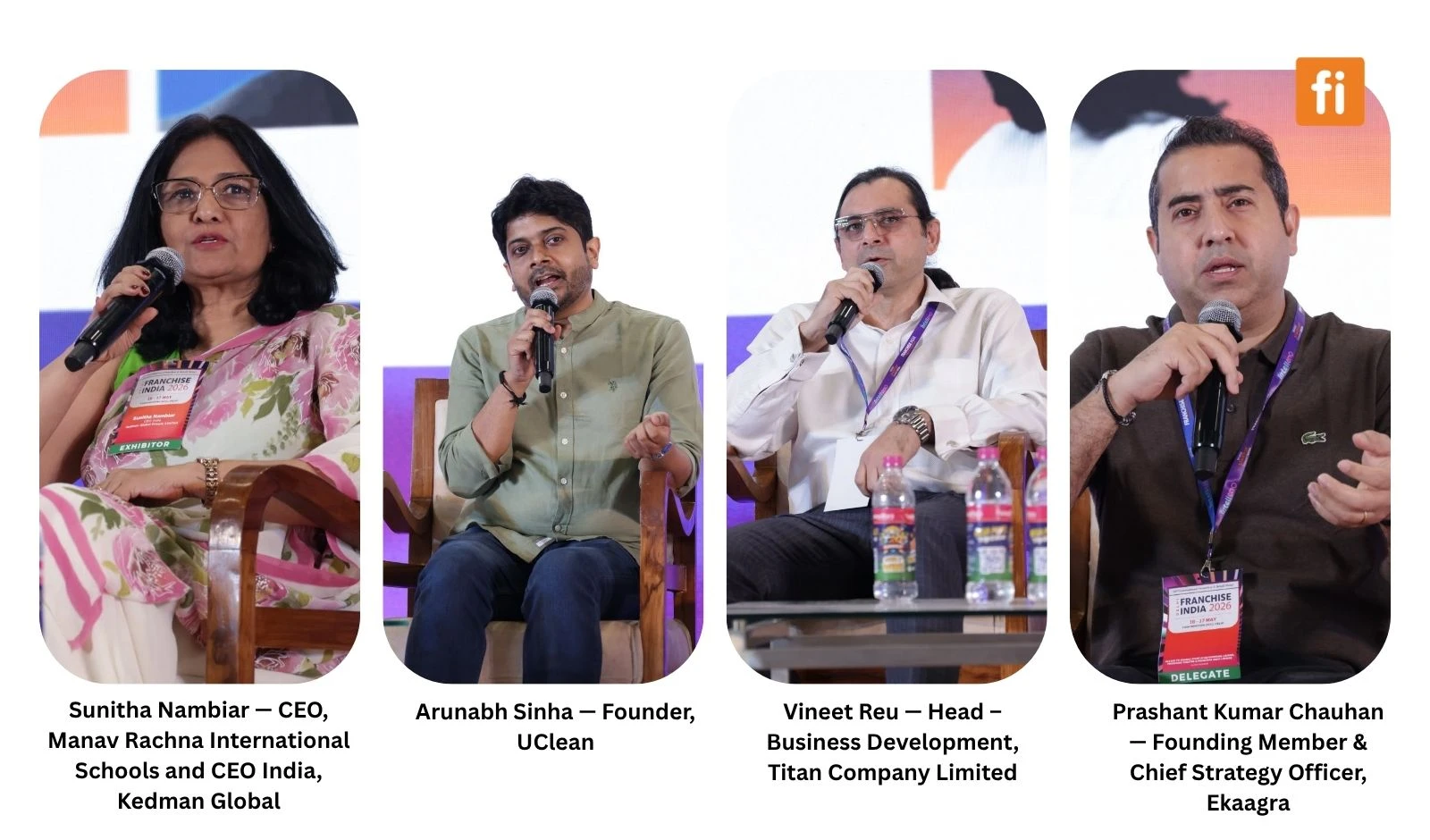
At The Bharat Brand Expansion Playbook session at recently held Bharat Startup Summit in New Delhi, organised by Franchise India, leaders from retail, hospitality, education and consumer services shared how successful brands are navigating this changing landscape. While their sectors differed, their message was remarkably similar: growth without strong foundations is no longer enough.
Organising India's Unorganised Opportunities
One of the strongest examples came from UClean, which transformed a largely unorganised industry into a scalable franchise business. According to Arunabh Sinha, Founder, UClean, the biggest opportunities often lie in sectors that are fragmented and underserved.
"Any industry that is massive in size and heavily unorganised is ripe for disruption. If you build strong systems, reduce manual intervention through technology and partner with the right entrepreneurs, scale naturally follows," says Sinha.
Today, UClean operates more than 900 stores across 250 cities and 10 countries, demonstrating how standardisation and technology can bring structure to even the most localised service businesses. For Sinha, growth is not about creating demand but about organising existing demand through trust, consistency and execution.
Consumer Relevance Comes Before Expansion
The importance of solving a genuine consumer need before pursuing expansion was echoed by Vineeth, Head – Expansion, North, Titan Company. He believes that sustainable growth begins with relevance.
"The first requirement for any brand is to create a compelling value proposition for the consumer. Once that need is identified, systems, processes and disciplined execution become the foundation of sustainable scale," he says.
As brands grow beyond their home markets, franchising often becomes an essential vehicle for expansion. However, Vineeth stresses that selecting the right partners is just as important as selecting the right locations.
"Local entrepreneurs bring invaluable market knowledge, but choosing the right partner is critical because they ultimately become the face of your brand," he adds.
His observations reflect a broader trend across India's franchise ecosystem. Increasingly, brands are evaluating franchisees not merely on financial capability but on their ability to uphold brand values and deliver a consistent customer experience.
Sustainable Growth Over Growth at Any Cost
The discussion also highlighted a growing shift in how businesses view profitability. For years, many companies prioritised expansion over financial discipline. Today, investors and operators alike are demanding a more balanced approach.
According to Prashant Kumar Chauhan, Founding Member & Chief Strategy Officer, Ekaagra which operates The Coffee Bean & Tea Leaf in India, growth and profitability should not be viewed as opposing goals.
"The answer is not growth at any cost. Equally, remaining profitable without expanding limits your relevance. The real answer lies in sustainable growth," he says.
Prashant believes brands should accelerate expansion only after validating their supply chains, unit economics and operational processes. Without these foundations, scale can quickly become a burden rather than an advantage.
His perspective reflects the changing investment climate, where disciplined execution and profitable expansion are increasingly valued over headline-grabbing growth numbers.
The Rise of the Aspirational Consumer
Consumer behaviour continues to reshape the expansion strategies of businesses across sectors. Today's consumers are more aspirational, informed and demanding than ever before. They expect convenience, quality and personalised experiences regardless of category.
Titan has witnessed this transformation firsthand. As Vineeth points out, brands can no longer rely solely on legacy or distribution strength.
"Consumers today are far more aspirational than they were a decade ago. Expectations around convenience, premium products and speed of service have changed significantly, and brands must continuously evolve to stay relevant," he notes.
The shift from the unorganised to the organised sector has accelerated across categories, creating significant opportunities for brands capable of delivering consistency, trust and superior customer experiences.
Education's New Consumer: The Parent
The changing expectations of consumers are perhaps most evident in the education sector. Academic excellence alone is no longer sufficient. Parents are increasingly evaluating schools and education providers on their ability to prepare children for a rapidly changing future.
According to Sunitha Nambiar — CEO, Manav Rachna International Schools and CEO India, Kedman Global education has become far more learner-centric than ever before.
"Parents today are no longer impressed simply by infrastructure. They want personalised learning, life skills, student wellbeing, global exposure and preparation for careers that may not even exist today," she says.
For Nambiar, the future of education lies in creating learning ecosystems that balance academic achievement with emotional wellbeing, adaptability and future readiness. The sector, much like retail, is shifting from a product-led model to an experience-led one.
The New Playbook for Scale
Collectively, these perspectives paint a clear picture of where India's franchise and retail economy is headed. The next generation of successful brands will not necessarily be the fastest-growing. Instead, they will be the ones that combine strong systems with local relevance, disciplined execution with innovation and expansion with profitability.
As India's consumer economy continues to evolve, the winners will be brands that understand a simple truth: sustainable growth is no longer a strategy, it is a necessity.