
 96
/ 10
Min Read
96
/ 10
Min Read


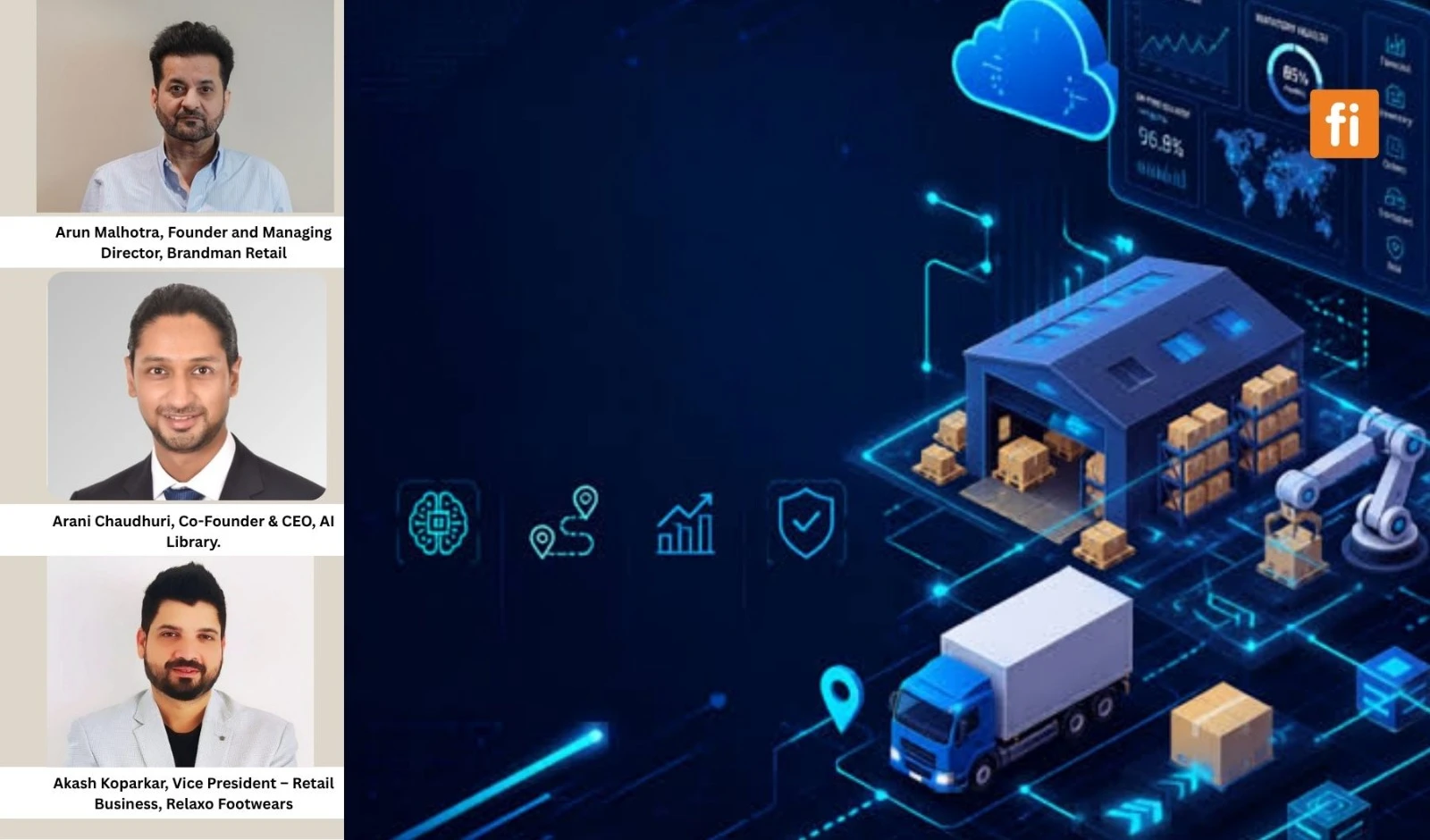
India’s retail scene is undergoing a quiet but significant transformation. Storefronts, warehouses and dealer networks that once ran on manual forecasting and periodic replenishment are now being rebuilt around real-time data. As consumer demand becomes increasingly unpredictable and omnichannel retail reshapes buying behaviour, retailers and brands are turning to artificial intelligence (AI) to modernise the way products move from production facilities to distributors, dealers, retailers and ultimately, consumers.
Three major shifts are driving this change:
- Quick commerce has dramatically raised consumer expectations for faster product availability. At the same time, the boundaries between physical retail, e-commerce, marketplaces and social commerce have blurred, requiring brands to maintain seamless inventory across multiple channels. Adding to this is the rapid consumption growth in Tier II and Tier III cities, where demand patterns are evolving just as quickly as in metropolitan markets.
- For businesses, traditional distribution models built on historical sales data, manual forecasting and periodic dealer replenishment are no longer sufficient. Excess inventory ties up working capital, stockouts lead to lost sales, and fragmented visibility across warehouses and dealer networks makes decision-making slow and inefficient.
- Artificial intelligence is helping brands overcome these challenges by transforming distribution into an intelligent, connected ecosystem. From predicting demand and optimising inventory to improving logistics and strengthening dealer relationships, AI is enabling companies to build resilient and agile distribution networks.
Acknowledging the pressing need to adopt technology, Brandman Retail has significantly enhanced its demand forecasting, inventory planning and stock allocation by harnessing AI, predictive analytics and digital tools. These technologies have enabled the company to make faster, data-driven decisions, optimise inventory across stores and online channels, and respond more effectively to changing consumer demand. Elaborating on the impact of this transformation, Arun Malhotra, Founder and Managing Director, Brandman Retail, said: “Our inventory thinking is anchored primarily in the sales data, read in conjunction with regional buying patterns and the preference shifts we track closely across our brand portfolio. Basing decisions on data has changed how we allocate stock. Products move to where demand actually exists, both on store shelves and across our online platforms, and the imbalances that once slowed us down have reduced considerably. Availability has improved as a result, and so has our working capital position. Perhaps the biggest shift, though, has been in responsiveness. When market demand moves, our planning now moves with it.”
Predicting Demand with Greater Precision
Demand forecasting has long been one of the biggest challenges for brands. Conventional planning often relied on previous sales trends and periodic market feedback. AI, however, analyses multiple real-time variables including regional buying patterns, weather, festivals, promotional campaigns and consumer sentiment, to predict demand with far greater accuracy.
Elaborating on how Relaxo is leveraging technology, data analytics and omnichannel capabilities to enhance in-store and online customer experiences, Akash Koparkar, Vice President – Retail Business, Relaxo Footwears, said: “Technology has become an essential enabler at every phase of retail. We are continually enhancing our digital capabilities by leveraging consumer insights and retail analytics to improve merchandising, plus inventory planning and overall store efficiency. Our omnichannel strategy also provides a consistent brand experience across physical stores and digital platforms. Every improvement is aimed at making the shopping experience easier as well as faster and more personalised. As technology advances, we expect more opportunities to create seamless interactions that build long-term customer relationships.”
For brands, this means inventory and replenishment can be aligned with actual market demand rather than assumptions. Whether it is an FMCG company planning festive-season supplies or a consumer durables brand preparing for regional demand spikes, AI helps ensure products reach the right markets at the right time while reducing excess inventory.
“The biggest shift is from projecting the past to reading the present,” says Arani Chaudhuri, Co-Founder & CEO, AI Library. “Forecasts can now weigh signals like weather, local events, promotions, and online interest, and predict demand right down to a single product in a single store. Inventory is no longer a static quarterly safety-stock number but a live decision that the system keeps adjusting.”
Smarter Inventory, Better Availability
Accurate forecasting is only the first step. Brands are increasingly using AI to optimise inventory across warehouses, regional distribution centres and dealer networks.
Instead of relying on fixed replenishment cycles, AI continuously monitors stock movement and recommends replenishment based on real-time demand. Products can be dynamically shifted between warehouses or distribution hubs to prevent shortages in one region and excess inventory in another. This improves product availability while reducing capital locked in unsold stock.
The result is a leaner supply chain where brands can maintain high service levels without carrying unnecessary inventory.
Commenting on how AI, automation and data analytics are helping Brandman Retail optimise supply chain planning, warehouse operations, replenishment cycles and inventory visibility to support an omnichannel retail strategy, Malhotra said: “Building a connected retail structure across stores, warehouses, marketplaces and our own direct-to-consumer channels has been a priority for us over the past few years. The goal was simple: know where every unit of stock sits, at any given time, regardless of the platform. Digital tools now support this by tightening replenishment cycles and improving how warehouses and fulfilment operations function day to day. What this has meant in practice is fewer delays and fewer gaps between what a customer expects and what is actually available. With real-time visibility into inventory, our teams can react quickly when demand shifts, and that translates, in the end, to a more consistent shopping experience across every touchpoint.”
AI Optimises Logistics
Distribution efficiency depends heavily on logistics, and AI is helping brands reduce both costs and delivery times.
Advanced route optimisation enables transporters to identify the most efficient delivery routes, while predictive maintenance reduces vehicle downtime. AI also improves vehicle utilisation by matching shipment volumes with available capacity, and provides accurate delivery estimates to distributors and dealers.
For brands operating nationwide distribution networks, these improvements translate into lower freight costs, faster replenishment cycles and greater reliability across the supply chain.
As Chaudhuri explains: “In the warehouse, vision systems and smarter slotting cut wasted movement and speed up picking. In logistics, route and load optimisation lower cost per shipment, while dynamic ETAs reduce the failed deliveries that quietly erode margin.”
Strengthening Dealer and Distributor Networks
For most brands, distributors and dealers remain the backbone of market expansion. AI is helping companies move beyond relationship-based channel management to data-driven decision-making.
AI-powered dashboards enable brands to monitor dealer performance in real time, identify underperforming territories, recommend optimal stock levels and improve incentive planning. Credit risk assessment has also become more sophisticated, allowing businesses to extend credit more confidently while reducing financial exposure.
This enables brands to respond proactively rather than waiting for quarterly reviews to identify declining sales or inventory gaps.
“The maximum return on investment has come from automating dealer management, often the least automated link,” notes Chaudhuri. “AI can read and reconcile orders, invoices and statements, predict each dealer’s demand, and flag credit risk early. It gives a real-time view of cost-to-serve by channel, enabling better decisions without compromising margins or agility.”
Creating Unified Distribution Networks
Brands today must supply products across multiple channels simultaneously, including traditional retail, modern trade, e-commerce platforms, direct-to-consumer websites and quick-commerce partners.
AI helps unify inventory across these channels, ensuring that stock availability remains consistent regardless of where consumers choose to shop. This integrated view enables brands to allocate inventory dynamically, reduce cancelled orders and improve fulfilment efficiency.
Rather than operating separate inventories for different channels, businesses can create a single intelligent distribution network capable of responding to changing demand in real time.
AI at the Frontline
Generative AI is also transforming how brands engage with distributors and field sales teams. AI-powered assistants provide instant access to pricing, product information and inventory updates, while conversational interfaces simplify order placement. Dealer queries can be resolved through intelligent chatbots, and digital training modules help onboard channel partners more efficiently.
These capabilities improve productivity while enabling brands to deliver a more consistent experience across their distribution ecosystem.
Preparing for the Future
While the benefits are significant, successful AI adoption requires strong data foundations, connected enterprise systems and organisational readiness. Fragmented information, legacy software and limited digital capabilities continue to be common barriers across organisations.
Highlighting the role that AI, real-time data, digital collaboration and intelligent supply chain management will play in strengthening Brandman Retail’s growth strategy and enhancing the consumer experience over the next five years, Malhotra said: “Retail distribution over the next several years will likely be shaped by how well companies use real-time data, not just to forecast demand but to build assortments that feel genuinely tailored to the consumer. That said, technology alone will not carry this shift. The collaboration between global brand partners, retail teams and supply chain stakeholders will matter just as much, and in many ways will determine who scales successfully and who does not. At Brandman Retail, we see this as a broader opportunity: to use data and digital tools not simply as operational support, but as a genuine lever for growth, one that helps us bring premium international brands closer to Indian consumers in a more thoughtful, efficient way.”
Chaudhuri identifies three recurring reasons projects stall: “Fragmented data spread across ERPs, spreadsheets and inboxes; weak adoption, where a capable tool gets built but never actually used; and over-scoping, trying to transform everything at once.” His advice: “Start with one painful, measurable workflow and capture a baseline. Keep people in the loop for judgement while AI does the repetitive work; that builds trust faster than a black box. One workflow that genuinely works makes the next ten easy to justify.”
Looking ahead, brands are expected to invest in AI-powered control towers, autonomous warehouses, robotics, digital twins and predictive supply chain management to build highly connected distribution ecosystems.
“The largest near-term impact will come from agentic AI applied to the messy, coordination-heavy work between organisations — the invoices, orders and back-and-forth where the manual effort actually sits,” says Chaudhuri. “Preparing for this is less an IT project than an operating-model shift: get your data foundation clean and connected, design for human oversight, and invest in people. The scarce skill ahead is supervising AI well, not building it.”
As competition intensifies and customer expectations continue to evolve, distribution is becoming a strategic differentiator rather than merely an operational function. Brands that successfully integrate AI across forecasting, inventory, logistics and dealer management will build smarter distribution networks that deliver greater speed, efficiency and resilience. In the years ahead, competitive advantage will depend not only on the quality of products brands offer, but also on how intelligently they move them to market.