 122
/ 13
Min Read
122
/ 13
Min Read


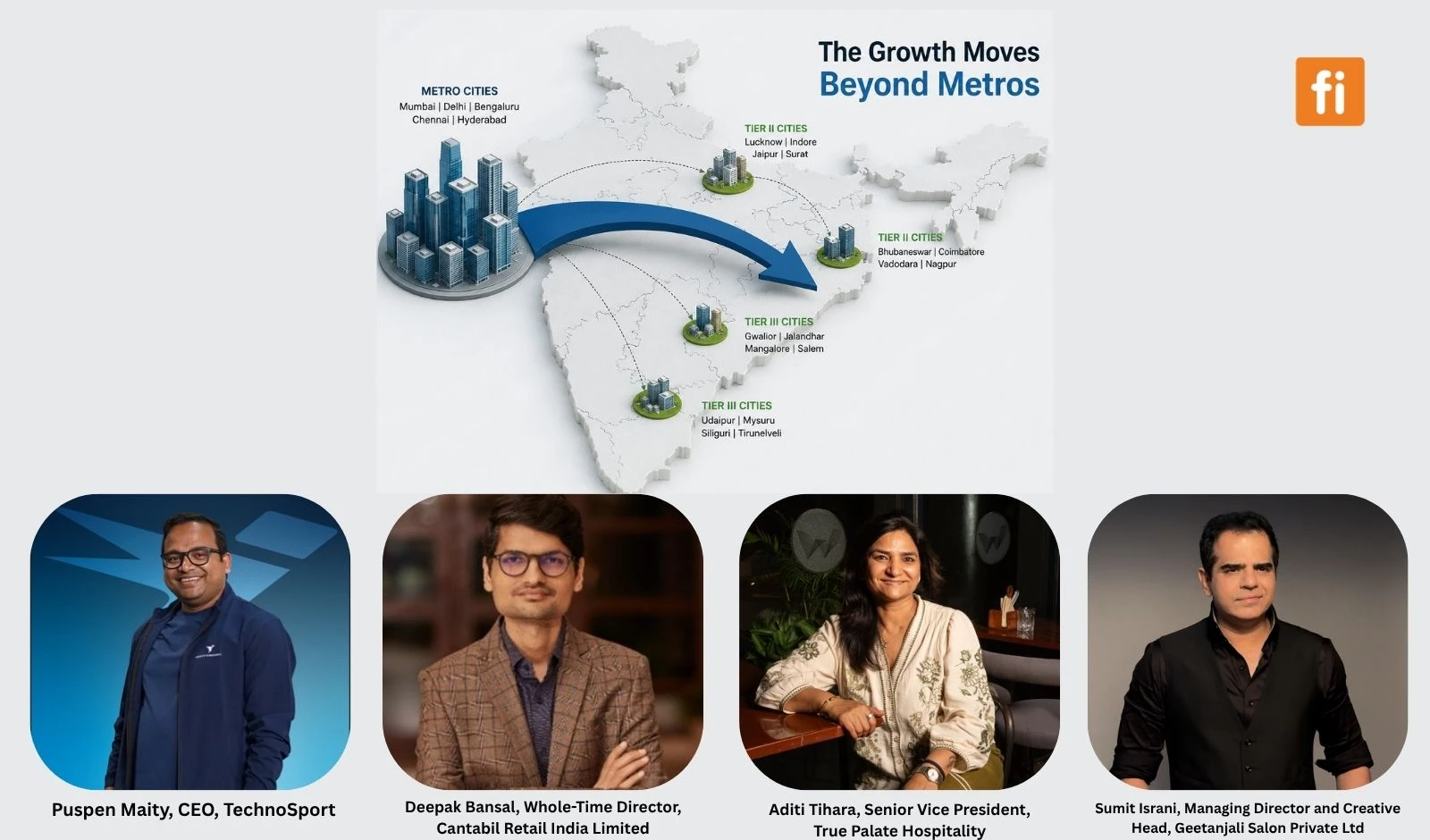
For years, India’s retail growth story was largely written in its metros. Delhi NCR, Mumbai, Bengaluru, Hyderabad, Chennai and Pune became the first destinations for brands seeking scale, visibility and affluent consumers. But as these markets become increasingly competitive and expensive, the next retail opportunity is taking shape beyond the traditional urban centres.
Tier II and Tier III cities are no longer simply the next locations on a store expansion map. They are becoming strategic markets with consumers who are increasingly informed, aspirational and willing to spend.
Validating the above, Puspen Maity, CEO, TechnoSport highlights, “TechnoSport’s growth strategy spans both metros and smaller cities, with Tier II and III markets playing an increasingly important role. These cities present a strong opportunity to bring organised, performance-led activewear closer to consumers whose aspirations are rising and whose demand for quality, functionality and accessible pricing continues to deepen. We scaled the network to 50 EBOs by the end of FY26 and now at the end of July 2026, opened our first store in Jharkhand and 66th overall. We are confident of opening at least 128-130 stores overall by the end of FY27.”
Backing the above Sumit Israni, Managing Director and Creative Head, Geetanjali Salon Private Ltd, highlights, “Premium beauty is no longer limited to metropolitan cities; consumers across emerging markets are increasingly seeking high-quality services, international brands and elevated salon experiences. Our market selection strategy is driven by a combination of consumer aspirations, economic growth, organised retail infrastructure and the strength of local entrepreneurial partners. Looking ahead, we believe Tier II and Tier III cities present one of the biggest growth opportunities for organised premium salon brands.”
Sharing similar thoughts is Deepak Bansal, Whole-Time Director, Cantabil Retail India Limited, “Crossing Rs 1,000 crore in turnover this year would be a significant milestone for us and a validation of the strategy we have followed over the last few years. Our move into larger store formats, especially in tier 1 and tier 2 towns, is already showing encouraging results, and we intend to build on this momentum as we prepare to enter South India in the next financial year.”
But there is a larger question brands need to ask: Are they entering these markets with the same strategies that worked in the metros, or are they prepared to understand what makes each market different?
The answer could determine who merely expands beyond metros and who actually builds a sustainable business there.
The Consumer Has Changed
The biggest shift is not happening in the market; it is happening in the consumer.
A customer in Lucknow, Jaipur, Chandigarh, Indore, Coimbatore, Surat, Dehradun or Bhubaneswar today has access to much of the same information as a consumer in Mumbai or Delhi. Social media, ecommerce platforms, influencers, streaming content and digital payments have significantly reduced the information gap between metros and smaller cities.
Extending her support to the above Aditi Tihara, Senior Vice President, True Palate Hospitality, highlights, “We have built True Palate Hospitality’s, specifically One8 Commune's expansion strategy around the shift. Our growing presence in cities such as Indore, Mohali, and Jaipur reflects our confidence in the long-term potential of these markets. Consumers here are increasingly seeking high-quality dining and entertainment experiences as those in metro cities. Their aspirations have evolved, their spending power has grown, and they are actively looking for destinations that offer more than just a meal, they want experiences they can connect with and be a part of. As aspirations become more uniform across the country, the demand for high-quality hospitality is no longer confined to India's largest cities.”
But has this created a uniform Indian consumer? Not necessarily.
A consumer may follow the same global fashion trend as someone in Mumbai but interpret it through local culture and lifestyle. A food consumer may be familiar with international QSR brands but still prefer flavours suited to regional tastes. A beauty customer may discover global skincare trends online but look for products suited to local climate and hair or skin needs.
This creates an important retail opportunity: consumers may have national aspirations, but their preferences remain local.
From Standardisation to Local Relevance
For years, retail expansion often meant replicating a successful metro format across new markets. But can a strategy designed for a metropolitan consumer simply be transplanted into a smaller city?
Increasingly, the answer is no.
Authenticating the above, Tihara informs, “The biggest shift is in expectations. Consumers in Tier II and III cities are no longer looking for a scaled-down version of a metro experience, they expect the same quality, creativity, and service standards, and they're willing to pay for it. At the same time, they value authenticity. They want brands to respect local tastes and culture rather than simply replicating what works elsewhere. That is why hyper-localisation is a key part of how we approach every new market. Across One8 Commune, Neuma, and Pincode, we adapt our menus, flavours, ingredients to reflect regional preferences while staying true to each brand's identity. We believe the best hospitality concepts strike a balance between consistency and local relevance.”
Hyper-localisation is emerging as an important part of retail strategy. It does not mean creating an entirely different brand for every market. Instead, it means maintaining a consistent brand identity while adapting elements of the proposition to local demand.
A fashion retailer may need to understand regional preferences in colours, silhouettes and occasion wear. A food and beverage brand may need to balance its core menu with local tastes. A home retailer may need to consider differences in housing formats and consumer priorities.
Authorising the above Maity informs; “Consumers are becoming more discerning in how they evaluate activewear, looking beyond price to consider comfort, fit, durability and functional performance. There is also greater awareness of fabric technologies and a stronger preference for products that can support multiple forms of movement throughout the day.”
The challenge is to determine what should remain consistent and what should be flexible. That balance could become one of the defining capabilities of successful retail expansion.
The Rise of the Experience Driven Store
Another question confronting brands is whether simply opening a physical outlet is enough.
Consumers in smaller cities already have access to a vast range of products online. They can compare prices, read reviews and discover new brands without visiting a store. So why should they walk into a physical outlet?
The answer increasingly lies in experience.
A store can provide discovery, trust, personalisation, product trials, assisted shopping and service in ways that digital platforms cannot completely replicate. For fashion and lifestyle brands, this could mean styling assistance and curated collections. Beauty retailers can offer consultations and services, while electronics and home retailers can use demonstrations to make products easier to understand.
For food and beverage brands, the store can become a social and community space rather than simply a place to purchase food. This shift is particularly relevant in smaller cities, where the arrival of a recognised brand can itself become a local experience.
As Tihara informs; “We've also found that consumers in these markets are incredibly engaged once they connect with a brand. They appreciate authenticity, reward quality, and build loyalty quickly when an experience feels genuinely crafted for their city rather than simply transplanted from a metro. That depth of engagement is one of the biggest opportunities in these markets.”
Local Intelligence Can Drive Expansion
As brands move deeper into smaller markets, the importance of local knowledge will increase.
Which neighbourhood offers the right catchment? Is the consumer more comfortable shopping in a mall or on a high street? What price points work? Which festivals drive demand? What products have the strongest potential? Which local influencers command attention?
These are questions that cannot always be answered from a central corporate office.
This is where franchise networks can play an important role. Local franchise partners can bring knowledge of real estate, customers, competition and community dynamics. Their understanding can help brands make better market entry and operating decisions.
Supporting the above Tihar said; “At True Palate Hospitality, we follow a franchise model where every outlet is company-operated. Our franchise partners are consciously and cautiously chosen to ensure they align with our vision and uphold the brand's standards.” She further highlights, “We are extremely selective about the franchise partners we work with, ensuring they share our long-term vision and commitment to upholding the brand's standards. This approach allows us to maintain control over every aspect of the guest journey, from the food and beverage programme to service, design and the overall experience. While it requires greater investment and a more measured pace of expansion, it enables us to build stronger customer trust and scale sustainably without compromising on quality or consistency. Whether it is One8 Commune, Neuma, or Pincode, every aspect of the guest journey, from the food and beverage programme to service, design, and overall experience is carefully curated.”
Highlighting the role of franchising, Israni informs, “Franchising has been one of the strongest pillars of Geetanjali Salon's expansion strategy. It has enabled us to scale efficiently while partnering with entrepreneurs who understand their local markets and share our commitment to quality and customer experience. Today, the majority of our network operates under the franchise model.”
However, franchising cannot become an excuse for inconsistent execution. Brands still need strong operating standards, training, technology, supply chains and customer experience guidelines.
To validate the above, Maity said, “TechnoSport Express is a compact format designed for faster entry into smaller towns, districts and neighbourhood catchments. We are targeting 25 Express stores by the end of FY27, alongside approximately 130 EBOs. The format will use our existing super-stockist and supply-chain infrastructure while creating opportunities for regional partners.”
The most effective model may therefore be one where centralised brand discipline meets decentralised market intelligence.
Technology Makes Hyper Localisation Possible
Hyper-localisation was once difficult to execute at scale. Technology is changing that.
Retailers today can use customer data, CRM platforms, loyalty programmes, inventory analytics and digital engagement tools to understand demand at a much more granular level.
A retailer can identify which products perform best in a particular city, which categories have the highest repeat purchase rates and when demand peaks. Such insights can influence assortment, inventory planning and promotions.
Omnichannel retail adds another layer. A customer may discover a product on Instagram, check availability through an app, visit a nearby store and complete the purchase offline. Alternatively, a product unavailable locally can be ordered digitally.
Technology can therefore help brands combine national scale with local responsiveness.
Maity informs, “For TechnoSport, technology connects consumer demand with fabric development, manufacturing, inventory planning and replenishment. This is particularly important for a multi-channel business operating across EBOs, general trade, large-format retail, marketplaces and its own website. By connecting manufacturing and distribution through technology, brands can improve demand forecasting, assortment and size planning, inventory visibility, replenishment speed and product availability across markets.”
Sharing her thoughts on the role of technology, Tihara authenticates “Technology has become the backbone of scalable hospitality. As we expand, it enables us to maintain consistency across locations without compromising on quality or guest experience. Centralised systems for inventory management, procurement, quality control, and operational performance allow us to make informed decisions in real time while ensuring every outlet adheres to the same high standards. Technology is equally valuable in understanding our guests. Digital reservations, customer feedback, loyalty programmes, and data analytics provide insights into consumer preferences, helping us refine menus, optimise operations, and personalise experiences for different markets. Instead of relying on assumptions, we can respond to changing consumer behaviour much faster, making our expansion more agile, efficient, and data-driven.”
Building a Retail Network Around Communities
As brands expand beyond metros, local engagement can become as important as location strategy.
Regional campaigns, local creators, community events and festival-led initiatives can make a national brand feel more relevant. Consumers are more likely to connect with brands that understand the culture and occasions that matter to them.
As Tihara opines, “Localisation will become a business imperative. As brands expand across diverse markets, success will depend on balancing consistency with local relevance, whether through menus, design, programming, or customer engagement. The brands that can adapt without diluting their identity will be the ones that build lasting customer loyalty and sustain growth over the long term.”
This does not mean abandoning national marketing. Instead, brands can create a broader national narrative and allow local markets to interpret it in ways that feel authentic.
For Maity. “The next phase of retail growth will be shaped by how effectively brands connect manufacturing strength with deeper market access. Store expansion alone will not be enough; success will depend on getting the format, assortment, pricing and replenishment model right for each catchment.” He further informs; “Consumers will increasingly expect better fabric, functionality and durability at accessible price points. Brands that combine local market understanding with product innovation, supply-chain discipline and consistent availability will be best positioned to scale.”
The result can be a retail network that is nationally recognisable but locally connected.
The Real Opportunity Beyond the Metros
So, is the next retail growth opportunity in India’s smaller cities? Clearly, the opportunity is significant. But the bigger opportunity lies in understanding how to win these consumers.
“Over the next five years, retail and hospitality growth will be shaped by four defining trends. First, Tier II and III cities will become central to expansion strategies as consumer aspirations and spending power continue to rise. These markets will no longer be viewed as secondary opportunities but as key drivers of long-term growth”, informs Tihara.
For brands, this means the old expansion equation needs to evolve. Store count alone cannot define success. The ability to understand local consumers, select the right formats, build strong partnerships, use technology intelligently and adapt the proposition without diluting the brand will become increasingly important.
The answer to the question posed at the beginning is therefore clear: brands should not take their metro strategy and simply transplant it into smaller cities. They need to build a national strategy that is flexible enough to become local.
The future of retail may not belong to the brands that reach the most cities. It may belong to the brands that understand each city best.