



 764
/ 5
Min Read
764
/ 5
Min Read


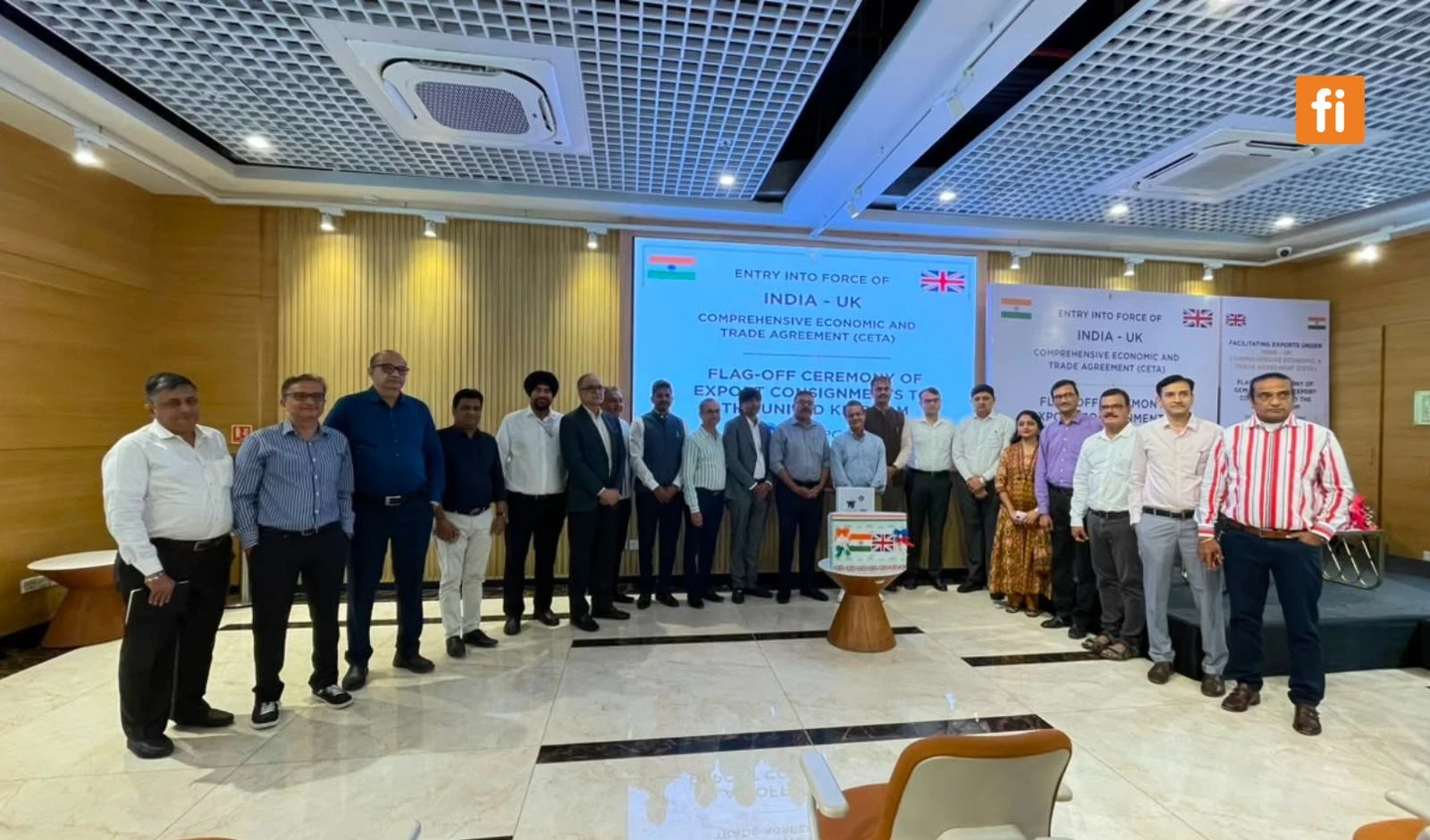
The India–UK trade pact isn't a policy footnote anymore. It's a shipment, a flag-off ceremony and a number, US$10 million of gold and diamonds that just left Mumbai for London.
There's a difference between a trade agreement existing on paper and a trade agreement moving cargo. India's gem and jewellery industry just crossed that line. The first consignment under the India–UK Comprehensive Economic and Trade Agreement (CETA), a deal formally titled the Comprehensive Economic and Trade Agreement which came into force in mid-2025 has left Indian shores and with it an industry's bet on what zero-duty access to Britain is actually worth.
The Numbers Nobody Can Ignore
Strip away the diplomatic language and CETA comes down to arithmetic. Britain will scrap duties immediately on 96.8% of tariff lines covering 97.7% of trade value. India reciprocates more cautiously, immediate relief on 64.1% of its tariff lines, a phase-out on another 21% and a protective ring drawn around sensitive sectors.
For Indian exporters the headline number is the one that used to sit between them and the British consumer: tariffs of 4% to 20% on goods that will now cross the border for nothing. That's not a marginal advantage. That's the difference between competing on price and simply winning on it.
Jewellery is the sharpest illustration. The UK's import tariff on Indian jewellery, as high as 4%, disappears entirely. The prize on the other side: a British jewellery import market worth roughly US$4 billion now open without the toll booth.
Mumbai Leads the Rest Of India Follows
If CETA needed a symbolic launch pad Mumbai supplied one. Flag-off ceremonies were staged at the Bharat Diamond Bourse, cleared through the PCCC (Precious Cargo Customs Clearance) facility and at SEEPZ, formally the Santacruz Electronics Export Processing Zone — now operating as a Special Economic Zone (SEZ) and among India's oldest and largest export processing hubs for gems, jewellery and electronics. Parallel events unfolded in Delhi, Surat, Jaipur, Chennai and Kolkata turning what could have been a single press release into a genuinely national moment.
The math behind the ceremony:27 exporters, six cities and one consignment worth US$10 million in gold, diamond, silver and platinum jewellery.
Kirit Bhansali, Chairman of the GJEPC, the Gem and Jewellery Export Promotion Council, the apex trade body representing India's gem and jewellery exporters, didn't undersell the moment: "The first jewellery export consignment to the United Kingdom under the India–UK CETA is a defining milestone for India's gem and jewellery industry."
His projection is the one worth watching: India's gem and jewellery exports to the UK, currently around US$754 million, could climb to nearly US$2.5 billion within three years.
At SEEPZ Development Commissioner Dnyaneshwar Patil put it in rupee terms familiar to the domestic trade, exports currently at roughly ₹3,000 crore with an expectation of doubling to ₹6,000 crore as the deal matures.
Mumbai Customs Commissioner Santosh Kumar framed his department's role as an enabler, not a gatekeeper: faster clearances and reduced dwell time so exporters aren't left holding tariff-free goods stuck in procedural limbo.
Shaunak Parikh, Vice Chairman of GJEPC, tied it back to geography, Mumbai's decades-old ecosystem of diamond trading and jewellery manufacturing built around institutions like the Bharat Diamond Bourse and SEEPZ now positioned to convert that infrastructure into fresh export volume.
Beyond Gold and Diamonds: The Rest of the Deal
Textiles, leather, footwear, marine products and processed foods, the classic labour-intensive export basket, all get the same duty-free run at the UK market. These are sectors where Indian pricing has historically had to work around tariffs rather than through them. CETA removes that obstacle wholesale.
Services get their own opening. The agreement expands market access across 137 sub-sectors - IT, business services, telecoms, finance and education, and eases the path for business visitors, transferees, investors and independent professionals to actually work in the UK, not just sell into it.
The Double Contribution Convention does the quiet unglamorous work here: it exempts eligible Indian professionals and their employers from paying into Britain's National Insurance system for stays of up to five years. An estimated 75,000 workers and 900 employers stand to benefit, a cost saving that turns marginal UK assignments into commercially obvious ones.
Procurement is the other lever. Indian suppliers gain access to a UK government procurement market worth roughly £90 billion. India offers reciprocal access worth around US$114 billion. Britain for its part secures phased tariff cuts on automobiles, a quota of 37,000 fully built units annually at preferential rates, plus openings in financial services, insurance, education and professional services.
Trade in Context: What the Numbers Already Show
India's trade ministry data offers a snapshot of where things stood even before the ink fully dried. India exported US$13.44 billion in goods to Britain and imported US$11.68 billion in 2025–26. Services trade between the two countries totalled US$35.44 billion in 2024 with India running a services surplus of nearly US$7.9 billion. CETA doesn't create this relationship from scratch. It accelerates one that was already tilted in India's favour.
The Bottom Line
Trade agreements are often announced twice, once when they're signed and once when someone actually ships something under them. India's gem and jewellery sector has now done the second part. A US$10 million consignment isn't a large number in the context of global trade but it's the number that turns CETA from a diplomatic achievement into a commercial fact. The exporters betting on a jump from US$754 million to US$2.5 billion in three years have essentially placed their order. Now it's a question of whether the rest of India's export economy, from Surat's textile floors to Kochi's marine processors, moves at the same pace as Mumbai's jewellers just did.

