


 519
/ 4
Min Read
519
/ 4
Min Read


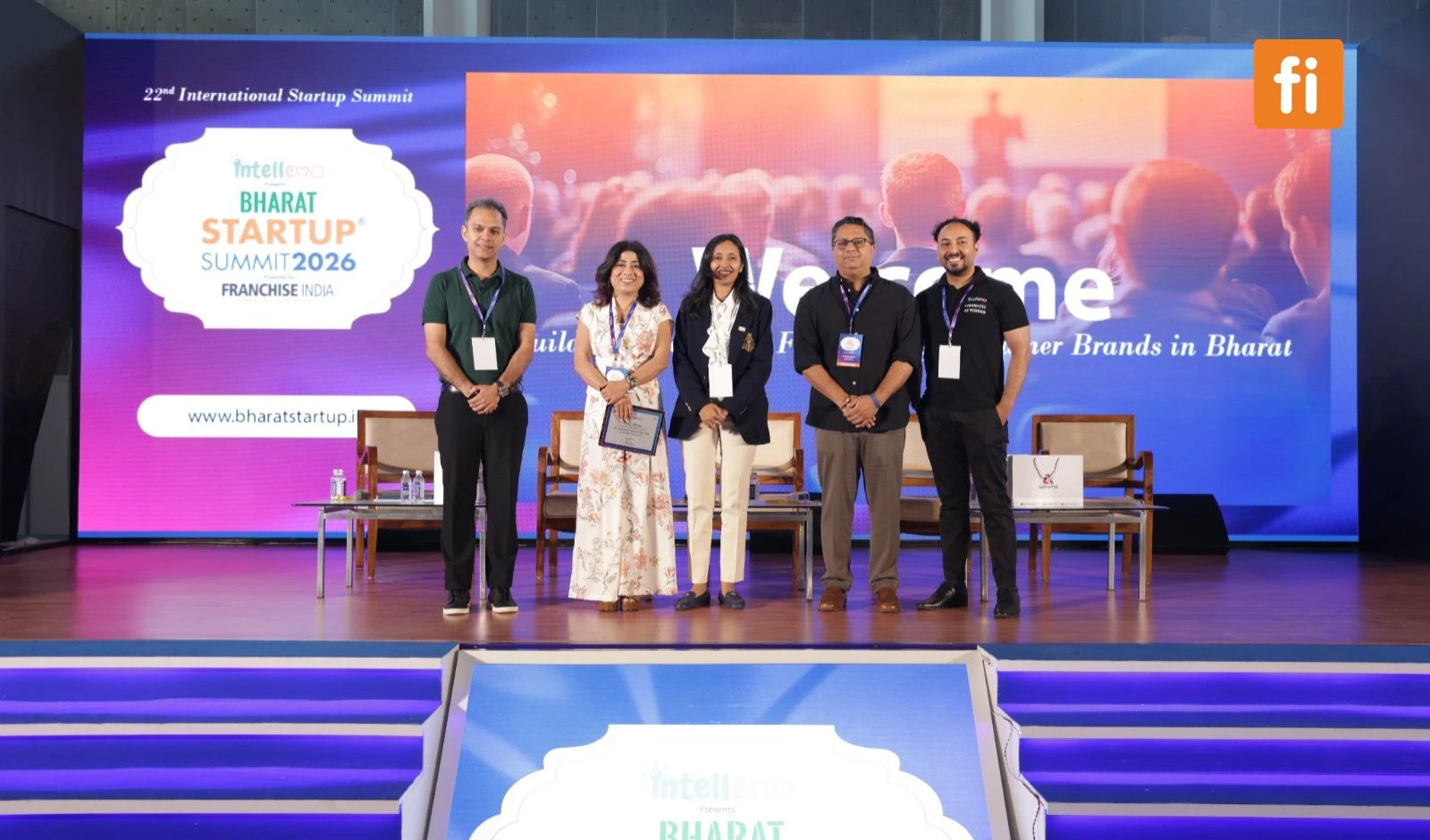
At a compelling panel discussion on “Building a Winning Consumer Brand: From Digital First to Market Leader” at Bharat Startup Summit 2026, industry leaders from Lahori Zeera, Fixderma, Wellbeing Nutrition and Intellemo, along with Ashita Marya, CEO, Franchise India highlighted how India’s D2C ecosystem has evolved far beyond experimentation. The discussion underscored that Indian brands today are creating world-class products while successfully navigating the competitive transition into physical retail. The founders shared a strong and unified belief that while the quality gap with global brands has closed, the remaining challenge is building deeper consumer trust. As international giants increasingly rely on India for sourcing, manufacturing and formulations, the panel emphasized that Indian consumers must now place greater confidence in homegrown brands that are shaping the future of the country’s consumer economy.
Consistency Wins the Shelf and the Consumer
Saurabh Munjal of Lahori Zeera puts it simply yet powerfully: “If there is consistency in what you deliver, consumers will surely pick it up.” In a market flooded with options, consistency is the ultimate differentiator. Indian D2C brands have invested heavily in standardizing formulations, supply chains and quality control.
Unlike the perception of “local = variable,” today’s serious Indian brands treat every batch as a promise. When consumers repeatedly find the same taste, efficacy or experience, loyalty follows naturally. This is not marketing speak, it is retail reality.
The Real Journey: Pipeline → Shelf → Consumer
Shaily Mehrotra of Fixderma brings the conversation down to brass tacks: “If you are able to move your product from the pipeline to the shelf — and from the shelf to consumers, you are already a winner.” She adds: “Brands are not made online, they are made in kirana stores.”
This is perhaps the most important insight for the entire D2C sector. While online helped these brands gain initial traction and validation, sustainable scale still happens in the unorganized retail network, the millions of kirana stores that reach every corner of India. Getting distribution, winning shelf space, and ensuring repeat purchases through these traditional channels is the true test of a brand’s strength. Indian D2C players who have cracked this are no longer “online-only” experiments; they are becoming mainstream consumer staples.
Offline Still Dominates for Many
Saurabh Kapoor of Wellbeing Nutrition reinforced this retail truth: “My products sell more offline than online.” This statement carries weight coming from a brand that built its early reputation digitally. Even for modern, science-backed wellness products, physical availability and the trust of the local retailer often drive higher volumes. It signals maturity, Indian D2C brands are not fighting traditional retail; they are successfully integrating with it. World-Class Quality, Made in India Across the panel, one belief stood strong: Indian brands today are fully capable of creating gold-standard products. The formulations, ingredients, research, and manufacturing standards match and in many cases exceed international benchmarks. The real challenge, as the founders noted, is building consumer trust and reinforcing that Indian brands are at par with, or better than, global names. This is especially relevant today because many international brands have quietly shifted their sourcing, manufacturing and even R&D to India to cut costs and leverage local expertise. The same factories, same raw material suppliers and sometimes even the same scientists now power both Indian D2C brands and foreign labels.
The key difference?
Indian brands often deliver better value, sharper innovation tailored to Indian needs, and greater transparency. Time for Indian Consumers to Trust Indian Brands The narrative that “imported = superior” is outdated. When international companies themselves choose India as their production base, it is proof that Indian manufacturing and innovation have arrived.
Indian D2C founders are demonstrating that success comes from:
- Relentless consistency in product delivery
- Mastering both digital acquisition and traditional distribution
- Obsessing over quality that stands shoulder-to-shoulder with global standards
- Building trust brick-by-brick, kirana store by kirana store
For consumers, the choice is clearer than ever. Supporting Indian brands is not an act of patriotism alone, it is a smart, rational decision backed by quality, accessibility and value. The products are ready. The supply chains are mature. The only missing piece is widespread consumer belief. As these D2C leaders have shown, Indian brands are not just surviving in retail, they are winning there. The next chapter belongs to consumers who recognise this shift and choose accordingly. Trust the consistency. Trust the shelf presence. Trust the quality that the world is already sourcing. Indian brands have earned it.

